 Vietnamnet.vn

 Podcast



Renewing promotion methods
At the fair, Vietnam’s pavilion drew strong interest from travel businesses, experts, and European visitors. According to organisers, Vietnam, along with Japan and Thailand, was among the Asian countries most searched for by French tourists, reflecting growing European attention to Southeast Asia and Vietnam.
Frederic Poirier, Regional Director for Southeast Asia, India and Oceania at Nomade Aventure, said Vietnam’s strength lies in its diverse tourism products, ranging from mountain and beach tourism to urban experiences and trans-Vietnam rail journeys. He noted that the country remains attractive thanks to its cultural diversity and ethnic communities.
Participation in international fairs and exhibitions has become a key pillar of Vietnam’s tourism promotion strategy. Earlier this month, Vietnam impressed visitors at the International Tourism Fair (ITB) Berlin 2026. In 2025, the sector also joined major events such as the World Travel Market in the UK, alongside promotion programmes in the Republic of Korea, Japan, and the Association of Southeast Asian Nations (ASEAN).
These events serve not only as promotion platforms but also as direct “touchpoints” with the market, helping Vietnamese enterprises grasp trends, establish partnerships, and seek opportunities in the global value chain.
Chairman of the Vietnam Tourism Association Vu The Binh said such exhibitions are effective channels for businesses to access customers and partners while expanding cooperation.
Behind these activities is the broader goal of enhancing the national tourism brand. As regional countries intensify promotion efforts, positioning Vietnam as a “safe–friendly–experience-rich” destination is crucial.
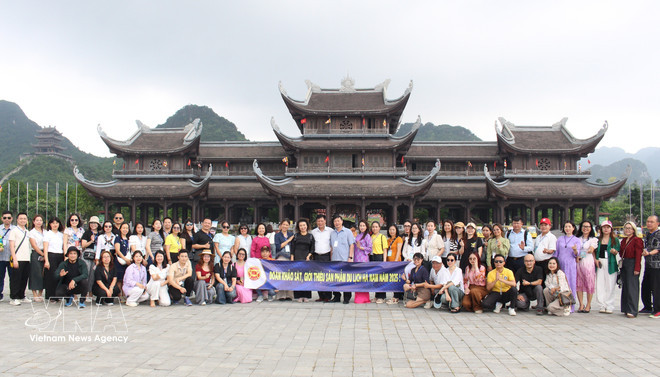
Vietnam’s promotion mindset is also shifting. While traditional methods relied on fairs and publications, the sector is now moving towards more dynamic approaches.
The Vietnam National Authority of Tourism (VNAT) has strengthened cooperation with global partners in visa and tourism services, marking a transition from “introducing destinations” to “building an experiential ecosystem.” VNAT has recently worked with VFS Global, one of the leading partners in the visa services sector, to explore opportunities for promoting tourism in key markets. This represents a shift from a single-channel to a multi-channel approach, and from simple introductions to genuine interaction and experiences.
At the same time, integrating traditional promotion with digital platforms is opening up new opportunities. Technologies such as virtual reality and artificial intelligence are enhancing promotional effectiveness while offering immersive experiences for potential visitors at the decision-making stage.
Efforts to make breakthroughs
Innovation is spreading from the central level to localities. The Hanoi Tourism Festival 2026 introduced a technology space for the first time, allowing visitors to explore the capital through VR360 and digital platforms, highlighting a blend of tradition and modernity.
In key destinations, market-oriented promotion is also gaining momentum. Khanh Hoa province has organised famtrip and presstrip programmes and invited international influencers to promote destinations through media and social networks.
Nguyen Quang Thang, Permanent Vice Chairman of the Khanh Hoa Tourism Association, said such initiatives not only promote destinations directly but also create spillover effects on digital platforms. The province has recently welcomed survey groups from Thailand and a famtrip delegation from Scoot airline, demonstrating a proactive approach to attracting visitors.
At the macro level, these efforts align with a broader strategy. The Ministry of Culture, Sports and Tourism has issued an action programme focusing on sustainable, high-quality development, market diversification, and digital transformation.
The sector aims to welcome 25 million international visitors and serve 150 million domestic tourists in 2026, with total revenue projected at about 1.125 quadrillion VND (42.7 billion USD).
Experts stressed that promotion must go beyond image-building and be closely linked with product development, service quality, and the tourism environment to ensure consistency between expectations and actual experiences.
Achieving these goals requires coordinated efforts from authorities, businesses, and local communities, alongside continued innovation in branding, human resources, and product development, as well as expansion into new high-potential markets to support sustainable growth./. VNA
.svg)
