From its 1945 revolution to today, Vietnam’s legacy is one of resilience, transformation, and an unyielding desire to shape a peaceful, independent future.
From the August Revolution in 1945 until today, Vietnam has undergone 80 tumultuous years, overcoming wars, division, blockades, sanctions, and poverty to gradually realize its aspirations for peace, independence, unity, and development.
President Ho Chi Minh’s immortal words, “Nothing is more precious than independence and freedom,” did not arise by chance. They have become the lifeblood and guiding truth of the Vietnamese people. Throughout centuries of struggle and upheaval, the nation has refused to submit to oppression, persistently resisting colonization and cultural assimilation to preserve its spirit, language, and cultural identity.
On September 2, 1945, at Ba Dinh Flower Garden (now Ba Dinh Square in Hanoi), President Ho Chi Minh, representing the provisional government, read the Declaration of Independence, proclaiming the birth of the Democratic Republic of Vietnam. That historic document not only affirmed Vietnam’s sovereign right to freedom and independence before its citizens and the world but also sent a powerful message about the nation's aspiration for peace and equality among all peoples.
However, that newly gained peace was soon threatened when French colonial forces returned to reoccupy Vietnam. Internal and external enemies piled on the challenges. Yet, the young government survived through these perilous times, described as “a thousand-pound weight hanging by a single strand of hair.”
The resistance war against the United States was the most intense and defining struggle of the 20th century. With unwavering spirit, the Vietnamese people endured relentless bombings and unimaginable hardships to defend every person, every inch of land. United in purpose, the nation rose not merely to survive but to shine - a people who refused to bow to the storms of history. The historic Ho Chi Minh Campaign during the Spring Offensive of 1975 led to the complete liberation of the South, reunifying the country and launching a new era of independence, unity, and socialist construction.
From the ashes of war, Vietnam rose like a phoenix.
A new aspiration: renewal, integration, and asserting global status
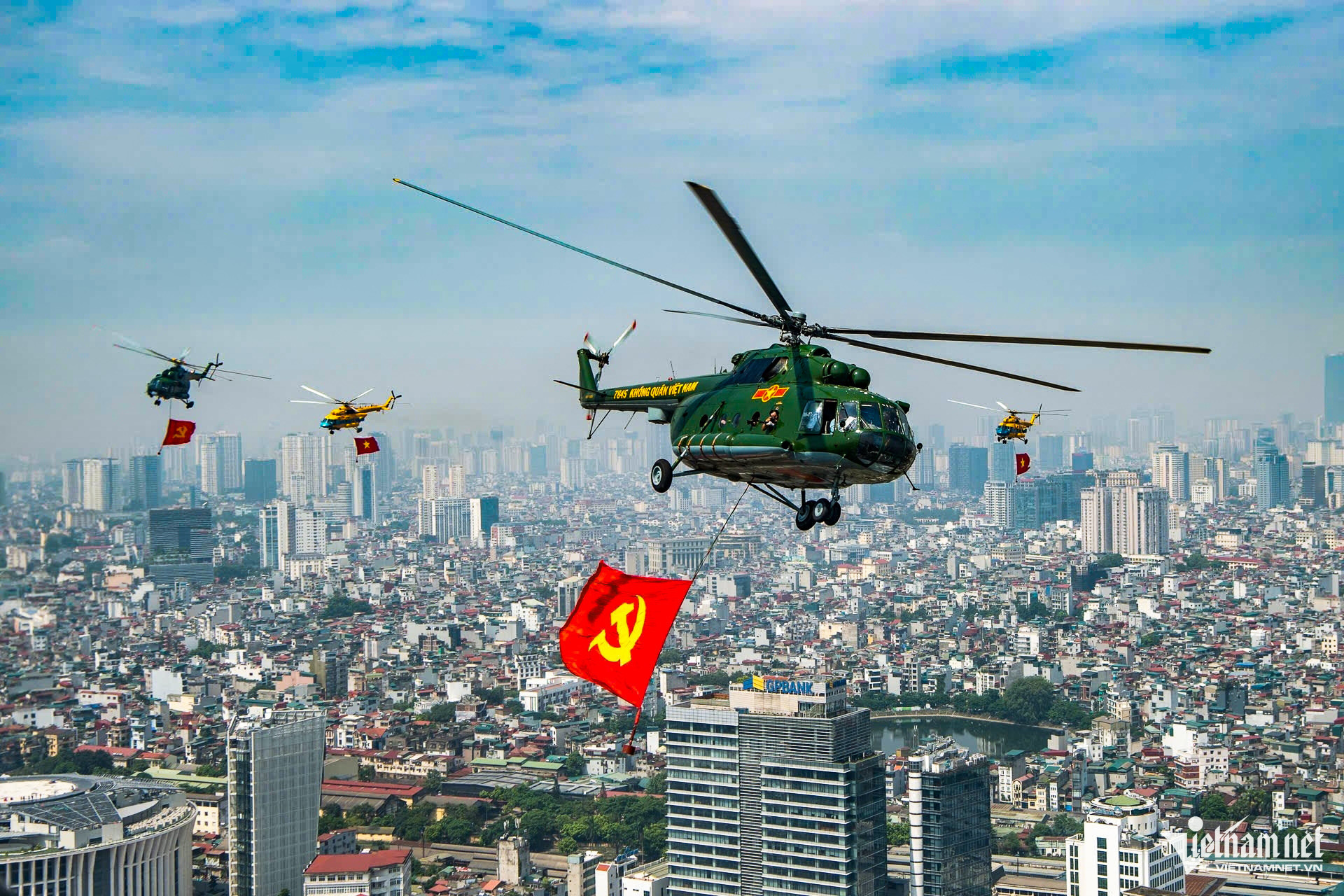
Helicopters fly flags during Air Force rehearsals over Ba Dinh Square in preparation for the 80th National Day celebrations. Photo: Duc Anh
After reunification, the desire for peace shifted toward preserving that peace for national reconstruction. Peace is a universal human longing, but independence remains the essence of Vietnamese identity. National independence must extend beyond political and territorial sovereignty to include economic, cultural, and intellectual autonomy for every citizen.
Vietnam’s aspiration goes beyond safeguarding territorial integrity - it aims to build a powerful and prosperous nation.
In 1986, the Sixth National Congress of the Communist Party initiated a comprehensive national renewal policy, with economic reform at its core. This was a historic turning point that unleashed creativity and mobilized national resources. The aim of transformation evolved from “alleviating hunger and reducing poverty” to achieving “a prosperous people, a strong nation, and a fair, democratic, civilized society.”
Nearly 40 years later, under the Party’s leadership, Vietnam has achieved remarkable progress. It is now one of Asia’s fastest-growing economies and a proactive member of major international forums and organizations, including the United Nations, ASEAN, APEC, and the WTO.
From being isolated and sanctioned, Vietnam has established diplomatic relations with nearly 200 countries and territories. No longer defined by war and hardship, the country is now seen as dynamic, integrated, and aligned with globalization and the Fourth Industrial Revolution.
As the 13th National Party Congress declared in 2021: “With all due humility, we can still proudly say that our country has never had the stature, potential, international position, and reputation as it has today.”
To remember is to show gratitude. And to be grateful is to honor and build upon the legacy of those who shaped Vietnam’s journey through renewal - for the present and for generations to come.
Aspirations for a new era
Streets in Hanoi’s Hang Ma area bustle with shops selling red-and-yellow flags, banners, shirts, hats, and other decorations for National Day.
From 1945 to 2025, Vietnam’s journey to peace, independence, and freedom has been a testament to its will and resilience, embodying President Ho Chi Minh’s ideals: “We would rather sacrifice everything than lose our country” and “Nothing is more precious than independence and freedom.” Today’s peace and freedom are the fruits of generations’ sacrifice, intellect, and bloodshed.
Few nations understand the true value of peace like Vietnam. After enduring multiple wars and witnessing villages vanish and cities be buried in bombs, the Vietnamese people know peace is more than the absence of war - it is a burning desire and the foundation of all progress. Yet true peace must be tied to independence and freedom. Peace born of submission, or built upon the trampling of sovereignty, is merely an illusion.
Today’s desire for peace goes beyond defending borders and sovereignty; it includes building a humane, safe, and innovative society. This is the rightful inheritance of generations who endured war, ensuring peace becomes a reality, not just an aspiration.
From the moment President Ho Chi Minh read the Declaration of Independence at Ba Dinh Square in the autumn winds of 1945 to today, each step of Vietnam’s journey has been marked by “peace stories” - historical achievements that honor the sacrifices of its forebears.
The goal of a peaceful, independent, and unified nation is not an abstract slogan. It is a continuous current, flowing from past to present to future. It is written into every heroic chapter of history, every mountain and river, and visible in each construction site, industrial zone, and integration milestone today. This aspiration is an eternal flame guiding the nation forward.
The 80-year journey has been filled with challenges and triumphs - a transformation from a colonized land to an independent nation overcoming sanctions to integrate and grow. It proves that the aspiration to rise is a powerful and enduring force that drives change.
This dream is not measured solely by GDP or competitiveness indexes but by the creation of a society where everyone can live, create, and thrive.
Vietnam’s ambitions go beyond national borders. It seeks to contribute to global peace and development - through its participation in UN peacekeeping, climate change commitments, and regional-global cooperation. Vietnam has affirmed an independent and self-reliant foreign policy while proving itself a responsible member of the international community.
In 2025, Vietnam enters a new stage of development, aiming to become an upper-middle-income country by 2030 and a developed nation by 2045. This modern aspiration includes deep integration, mastery of science and technology, digital transformation, improved human capital, and a green and digital economy - all while ensuring national defense and sovereignty amid global uncertainties.
This proud 80-year journey is living history, proving that peace, independence, and freedom do not come easily. They must be preserved through unity, wisdom, and compassion. Once peace becomes reality, it serves as a launching pad, a driving force, and a beacon lighting the way to a new era and a brighter future.
 Vietnamnet.vn

 Podcast




.svg)
