 Vietnamnet.vn

 Podcast



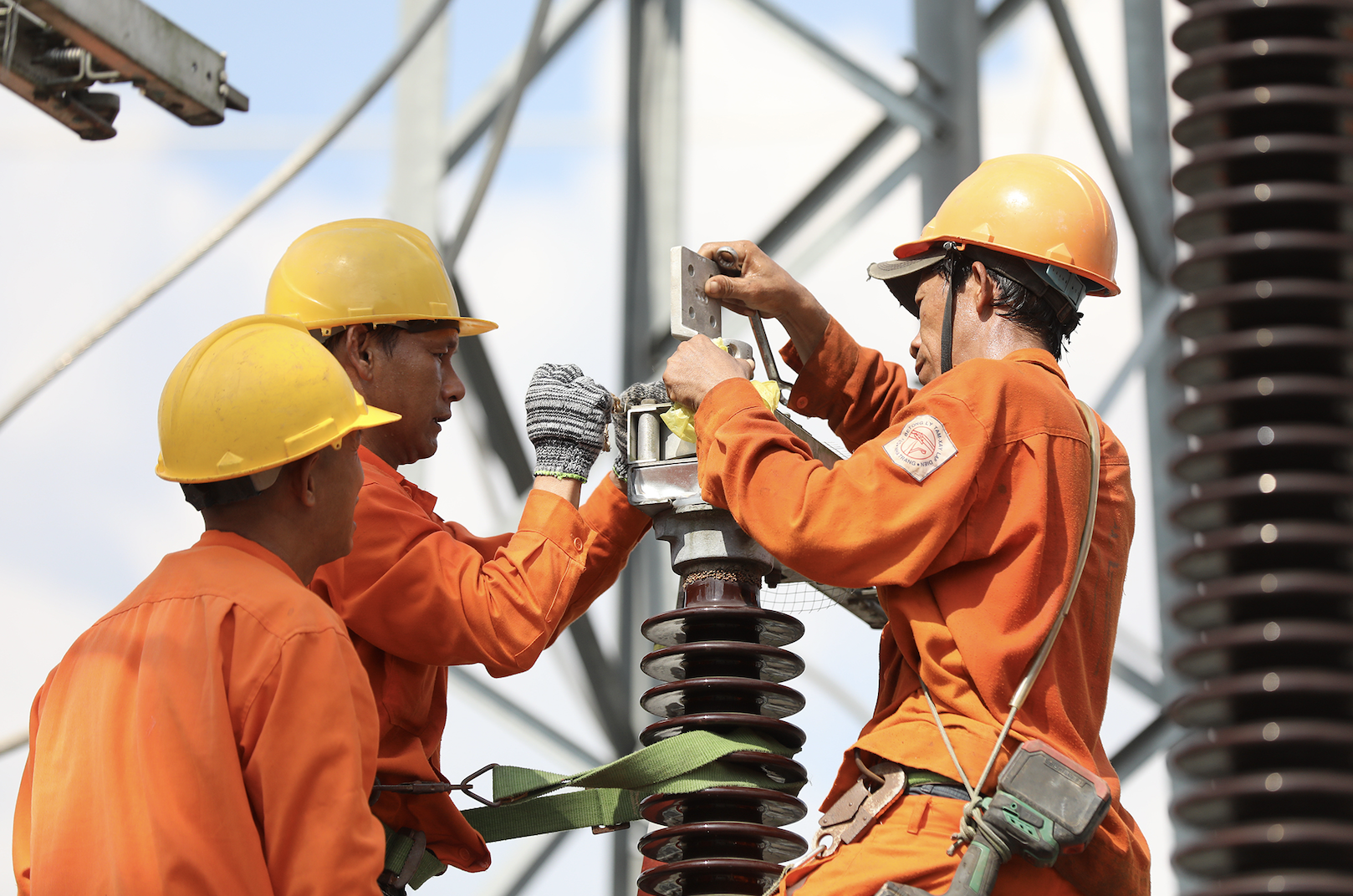
The Ministry of Industry and Trade has submitted a report outlining measures to secure electricity supplies for 2026-2030 and proposing further adjustments to Vietnam's Power Development Plan VIII.
Notably, the ministry has asked the government to approve in principle the transfer of the state's ownership representation at Vietnam Electricity (EVN) to the Ministry of Industry and Trade, giving it sufficient personnel and resources to implement the power plan once approved.
The Ministry of Finance currently exercises the state's ownership representation rights at EVN.
Alongside the proposed transfer, the Ministry of Industry and Trade has recommended that the government issue a resolution setting out key tasks and measures to secure electricity supplies for socioeconomic development and help support double-digit economic growth during 2027-2030.
The ministry has also proposed allowing Power Development Plan VIII to be adjusted in two stages.
In the first stage, the plan would be updated in accordance with Resolution No. 253/2025/QH15. Under the proposal, new coal-fired power projects could be added to compensate for delays to other baseload generation projects, including LNG and coal-fired plants, while renewable energy sources that can be deployed quickly could be added to make up for projects that have yet to move forward.
These measures are intended to meet electricity demand in northern Vietnam during 2027-2028 and in the south during 2029-2030.
The second stage would involve a comprehensive adjustment of Power Development Plan VIII in accordance with the Law on Planning. Projects incorporated into the plan during the first-stage update would form an integral part of the broader revision.
At a recent meeting with Standing Deputy Prime Minister Pham Gia Tuc, EVN Chairman Dang Hoang An said the group had focused during the first eight months of 2026 on operating the power system and ensuring electricity supplies for socioeconomic development, while its production, business and financial indicators continued to improve.
Electricity generation and imports across the system reached 235.82 billion kWh, up 9.3% from the same period in 2025, while commercial electricity output rose 9.8% to 210.4 billion kWh.
In the first eight months, EVN's investment workload was estimated at VND76.82 trillion ($2.91 billion), equivalent to 62.2% of its annual plan, while disbursements reached VND69.54 trillion ($2.63 billion), or 56.3% of the plan.
EVN started construction on 118 power-grid projects ranging from 110 kV to 500 kV and energized 116 projects. Several major power-generation projects also continued to move forward.
On the financial front, Dang Hoang An said that after a difficult period in 2022-2023, EVN had implemented a range of cost-cutting measures, adopted more flexible management and restructured its operations. By June 30, 2026, EVN said it had eliminated accumulated losses from previous years.
EVN recorded revenue of VND482.04 trillion ($18.26 billion) in the first eight months, with estimated profit of VND12.22 trillion ($463 million) and state budget contributions of around VND17.16 trillion ($650 million). Its key financial safety indicators remained secure, although the substantial capital required for power-system development in the coming years has increased the need to raise more long-term funding.
For the remainder of the year, EVN aims to ensure electricity supplies under all scenarios, with power demand forecast to rise by around 10.5-12% in the final four months.
EVN is also targeting a 2026 profit of more than VND13.5 trillion ($511 million) and state budget contributions exceeding VND26.3 trillion ($996 million), while continuing to cut costs, reduce waste, improve operational efficiency and generate additional resources for investment.
According to EVN, one of the biggest challenges to securing future electricity supplies is rapidly rising demand while progress on new generation capacity remains uneven among investors. Some projects developed by private and foreign investors have been delayed, posing risks to the timetable for adding planned generation capacity.
Under the revised Power Development Plan VIII, Vietnam's electricity system needs to add around 93,000 MW of generation capacity by 2030. EVN has been assigned to invest in and complete about 6,066 MW of generation capacity and around 1,700 MW of energy storage systems. The remaining capacity will be developed by other investors, requiring decisive measures to keep projects on schedule.
With electricity demand forecast to continue growing by around 10-12% annually, maintaining adequate reserves and safe power-system operations is becoming increasingly important. Meanwhile, LNG-fired and offshore wind projects require substantial capital and have long investment payback periods, creating a need for appropriate mechanisms to facilitate financing and accelerate investment.
Tam An
.svg)
