 Vietnamnet.vn

 Podcast



The success of films such as “Mua do” and “Dia dao: Mat troi trong bong toi” lies in their decision to approach history not as a chain of events to be memorized or a lesson to be extracted, but as a lived experience, where audiences are immersed in the space, rhythm, sensations and choices of people in wartime.
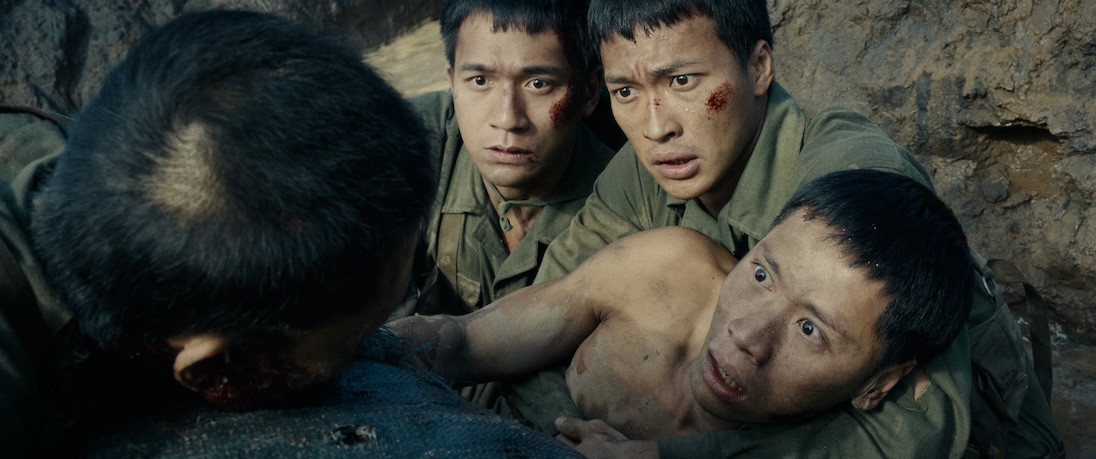
For many years, historical and war films in Vietnam were mentioned with a certain hesitation. They were seen as “difficult to produce” and “hard to sell,” burdened more with educational duty than aesthetic exploration. The breakout success of “Dia dao: Mat troi trong bong toi” and especially “Mua do” in 2025 is not merely a box office phenomenon, but a cultural sign worth careful reflection. The more pertinent question is not why these two films succeeded, but what contemporary need they have met - and what that need reveals about the relationship between cinema, history and social memory today.
When history returns as experience
Vietnamese cinema once produced war and historical works that became part of the country’s cultural memory. But after Doi Moi, the market operated under a new logic: instant, low-cost, fast-return genres gained dominance, pushing historical films into risky territory. As a result, the market did not simply lack historical works; it also disrupted viewing habits. Younger audiences grew up with entertainment-driven narratives, brisk pacing and international technical standards. Domestic historical films, meanwhile, were often expected to be “accurate,” “exemplary,” at times little more than illustrations of textbook events.
The return of “Dia dao: Mat troi trong bong toi” and “Mua do” reestablishes a new way of narrating history. Their most important shared feature is this: history is no longer presented as a sequence of facts to remember or morals to draw, but as a lived experience. Viewers are placed inside the space, rhythm, sensations and decisions of individuals at war. This shift in storytelling has allowed history to find its way back to young audiences - a generation well informed, yet in need of emotional experiences deep enough to engage the past in dialogue.
The question of the price of peace
Recreating the 81 days and nights at the Quang Tri Citadel, “Mua do” adopts a deliberately limited perspective: a group of young soldiers, many of them students, entering war before their lives have fully begun. It is a strategic narrative choice. When history is told through those who have not yet had the time to become heroes, it becomes more accessible and avoids the familiar trap of idealization.
In “Mua do,” large-scale staging creates a palpable sense of presence. Audiences do not merely watch war; they feel as if they are inside it. Yet what gives the film its weight is not spectacle, but small moments: a glance before a charge, an unfinished sentence, a death that arrives without warning. These details render war as a continuous state of unease, where every decision might be the last.
More importantly, “Mua do” does not position viewers in pure admiration. It quietly but persistently confronts them with a question: what was exchanged to secure today’s peace? When characters close in age and temperament to the audience are swept into the machinery of war, history ceases to be a story of distant generations and becomes a direct projection onto the present. At this point, the film transcends entertainment or propaganda and turns into a space for historical contemplation, where emotion does not overwhelm thought but opens the way for it.
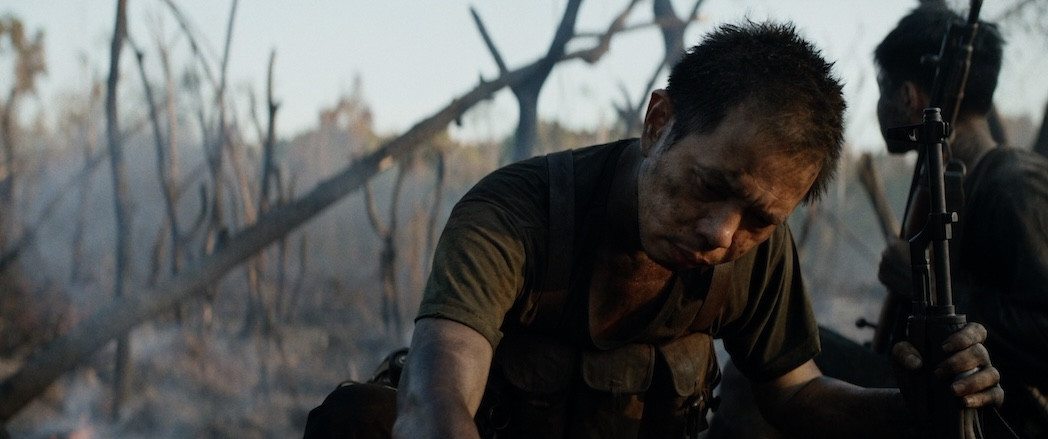
If “Mua do” unfolds war across the horizontal vastness of open battlefields, “Dia dao: Mat troi trong bong toi” chooses depth - both literal and metaphorical. The Cu Chi tunnels are not merely a setting but a narrative device. In cramped darkness, deprived of light and air, history is first felt through the body: breath, exhaustion, the sensation of confinement.
“Dia dao: Mat troi trong bong toi” avoids conventional dramatic peaks. Instead, it sustains a prolonged tension, where danger arises not from explosive climaxes but from steady erosion. Viewers are not swept away by action but held in a lingering sensation - the feeling of living in minimal conditions while still having to make moral choices.
The characters are not constructed as symbols. They appear with deeply human limitations: fear, fatigue, at times helplessness. Yet it is precisely this imperfection that lends credibility. The film does not declare heroism; it allows heroism to emerge quietly through small, repeated, persistent acts. Here, the “sun in the darkness” is not a romantic metaphor but an aesthetic statement: the light of history resides not in dazzling moments, but in the capacity to preserve humanity under inhuman conditions.
The need to shape a shared memory
From “Mua do” and “Dia dao: Mat troi trong bong toi,” a clear tendency can be observed: contemporary audiences are not turning away from history; they are turning away from outdated modes of narration. When history is told in a modern cinematic language, when personal emotion is allowed to coexist with knowledge, viewers are willing to engage.
At a social level, the warm reception of these films reflects a need to restructure shared memory in contemporary Vietnam. As life grows increasingly fragmented and personal memory is shaped by short-term information flows, cinema - with its capacity for collective experience - becomes one of the few spaces where society can look back together.
This places Vietnamese historical cinema within a broader global current. From South Korea and China to Hollywood, the most successful historical and war films do not triumph through slogans, but through their ability to transform history into sensory and moral experience. With “Mua do” and “Dia dao: Mat troi trong bong toi,” Vietnam is entering that orbit.
An open prospect, but not a miracle
The success of the two films in 2025 is an encouraging signal, but it should not be mistaken for a miracle. If Vietnamese historical cinema wishes to continue reaching the public, what is needed is not formulaic repetition but a sustained seriousness toward both history and audiences.
This includes long-term investment in screenwriting, historical research and cinematic storytelling, while acknowledging that history does not speak with a single voice. Future historical films may not need to be grander in scale, but they must be deeper - in their portrayal of human beings, moral conflicts and the questions history leaves for the present.
On another level, the phenomenon of “Mua do” and “Dia dao: Mat troi trong bong toi” invites reconsideration of the relationship between cinema and historical education. For years, school history has largely been approached through texts, dates and events, while cinema - if handled with seriousness - can add another dimension: that of feeling and empathy. When young viewers leave theaters wanting to learn more about the Quang Tri Citadel or the Cu Chi tunnels, this is not propaganda at work, but a sign of intrinsic motivation awakened through aesthetic experience.
Historical film, then, should be seen as an open space - one where history is placed under question. Audiences do not merely receive information; they confront issues of choice, responsibility and values. In a rapidly changing society, where young people must constantly make decisions, stories from the past told through cinematic language can become an important moral reference, helping them imagine the cost of every choice.
“Mua do” and “Dia dao: Mat troi trong bong toi” may be regarded as the first swallows of a new season. Their greatest value lies not in signaling the revival of a genre, but in demonstrating that history still has the capacity to converse with the present, if told in a language that respects both the intelligence and emotions of viewers.
In the early days of the year, the sight of young audiences filling theaters for historical films suggests a generation not indifferent to the past, but searching for new ways to understand and carry it forward. When cinema achieves this, it contributes to shaping how a society remembers itself.
Dr. Dao Le Na
.svg)
