 Vietnamnet.vn

 Podcast



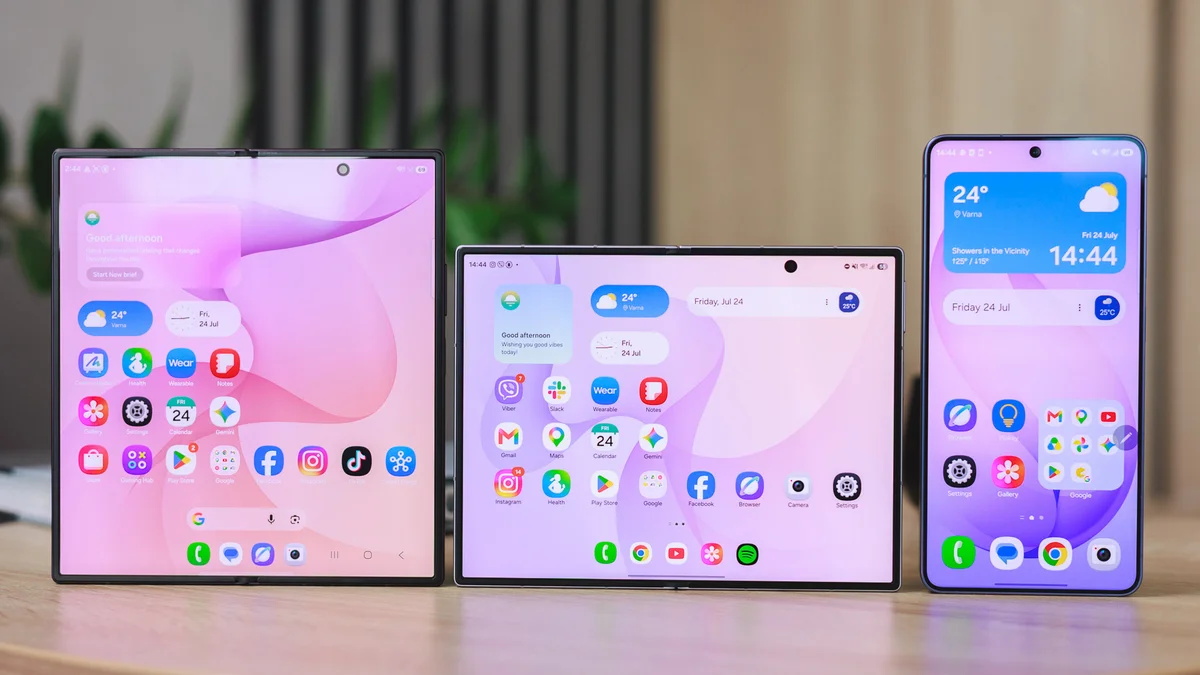
The Galaxy Unpacked event on July 22 marked a major turning point in Samsung’s foldable smartphone strategy.
Instead of offering a single Galaxy Z Fold model as it had done for the previous seven generations, the South Korean technology giant has officially divided the lineup into two distinct versions designed around different types of use.
At the top end is the Galaxy Z Fold8 Ultra, starting at $2,099.99 and serving as the direct successor to the Galaxy Z Fold7.
The Galaxy Z Fold8, meanwhile, starts at $1,899, while the Galaxy Z Flip8 is priced from $1,199.99.
All three devices will officially go on sale from August 7, just weeks before Apple is expected to unveil its first foldable iPhone in September.
That timing is set to make competition in the foldable smartphone market considerably more interesting.
Galaxy Z Fold8 Ultra lives up to the Ultra name
The biggest differences in the Galaxy Z Fold8 Ultra are not immediately visible in its design, but rather in the hardware underneath.
Battery capacity has increased from 4,400 mAh on the Galaxy Z Fold7 to 5,000 mAh, an improvement of around 14%.
More notably, Samsung has managed to make the device thinner rather than sacrificing portability with the bulkier design seen on many earlier foldables.
Fast charging has also received a significant upgrade, rising from 25W to 45W. According to Samsung, the device can replenish around 67% of its battery in approximately 30 minutes.
This is also the first time Samsung has confirmed the use of a silicon-carbon battery in its new foldable lineup.
The technology has been adopted by several Chinese smartphone manufacturers in recent years because it can increase energy density without requiring a larger battery.
The Galaxy Z Fold8 Ultra features an 8-inch main display with a pixel density of 422 ppi, significantly higher than the roughly 368 ppi offered by its predecessor.
For photography, Samsung has equipped the device with a 200MP main sensor, an all-new 50MP ultrawide camera and a 10MP telephoto camera offering 3x optical zoom.
The phone measures just 4.1mm thick when fully unfolded, weighs 215g and features a display structure reinforced with titanium material for greater durability.
One detail also worth clarifying is that earlier rumors suggesting the inner display would reach a pixel density of 500 ppi did not materialize.
The official figure is 422 ppi. While lower than some had expected, it still represents a significant improvement over the previous generation.
Should existing foldable owners upgrade?
For Galaxy Z Fold7 owners, the Galaxy Z Fold8 Ultra is arguably one of the most compelling upgrades Samsung has offered in years.
The main reasons, however, are not related to design but to longer battery life and faster charging.
For those still using a Galaxy Z Fold6 or an older generation, the differences in performance, display quality, cameras and battery life are even greater, making an upgrade easier to justify.
For buyers considering the Galaxy Z Fold8 Ultra against the Galaxy Z Fold8 to save around $200, the trade-offs are worth understanding.
The Galaxy Z Fold8 weighs just 201g, making it the lightest Galaxy Z Fold model Samsung has ever produced.
Its spacious 4:3 display is designed to provide a better experience for watching videos and gaming. However, it comes with only a dual 50MP camera setup, drops the telephoto camera and reduces battery capacity to 4,800 mAh.
For iPhone 17 Pro Max users considering a move to a foldable, Samsung’s latest approach is also worth examining, particularly with Apple’s first foldable iPhone expected to arrive in September.
Who is the Galaxy Z Fold8 Ultra really for?
In practice, choosing among Samsung’s three new foldable phones is less about how much buyers can afford and more about how they intend to use their device every day.
The Galaxy Z Fold8 Ultra is best suited to users who regularly multitask, edit photos, shoot video, need a telephoto camera and want the best possible battery life.
The Galaxy Z Fold8, by contrast, is aimed at users who prioritize entertainment such as watching movies, reading e-books or gaming on a large display, while still wanting a device that is light and easy to handle.
The Galaxy Z Flip8 remains the option for those who prefer a smartphone with conventional dimensions when in use but want it to fold down into an exceptionally compact device for carrying around.
There is another factor that rarely stands out on a specification sheet but has a direct impact on everyday usability: the dimensions of the phone when folded.
The Galaxy Z Fold8 Ultra is only 72.8mm wide, making it relatively secure to hold. But at 158.4mm tall, one-handed operation can still be difficult, particularly for people with smaller hands.
The Galaxy Z Fold8, by comparison, is surprisingly short when folded, measuring just 123.9mm tall — around 35mm shorter than the Ultra.
That makes it easier to reach the entire cover display with one hand, although the trade-off is a wider 81.9mm body.
This can be particularly relevant for many women, as women’s clothing often comes with very small pockets or no pockets at all.
A shorter phone that fits more easily into a small handbag can offer a noticeable advantage in everyday use.
Since foldable smartphones first appeared in 2019, their biggest promise has always been the ability to offer a large display while remaining easy to carry.
At just 201g and with its new design, the Galaxy Z Fold8 is moving closer to fulfilling that promise.
At the same time, Samsung’s decision to expand its foldable lineup into three distinct products suggests the company is increasingly designing phones around the real-world needs of different users rather than trying to create a single device for everyone.
Hai Phong
.svg)
