 Vietnamnet.vn

 Podcast



Editor’s note: Behind the glamour of the stage lie sweat, tears and, for many artists, the struggle to make a living under an outdated, one-size-fits-all compensation system. Seeking to remove these long-standing constraints, Decree 287/2026/ND-CP introduces a significant new mechanism for “incentive royalties,” allowing creators to receive up to 10% of the profits generated by their own works.
To provide a broader perspective on this legal turning point, VietNamNet is publishing the series "New mechanisms for artistic royalties - Unlocking creativity", examining the opportunities and challenges involved in bringing Vietnam’s performing arts fully into the orbit of the cultural industries.
Decree 287/2026/ND-CP will officially take effect on September 1. With the mechanism now in place and the rules clearly defined, arts organizations must be prepared to move beyond the safety of state subsidies and learn how to survive in the market, while artists themselves must learn to become genuine stewards of their intellectual property.
A way forward for private investment in the arts
For decades, public arts organizations have often been constrained by a rigid, closed financial cycle: receive state funding, stage a production for appraisal and acceptance, then put it into storage and wait.
Efforts to mobilize outside investment, often referred to in Vietnam as “socialization,” for major productions have frequently stalled because compensation mechanisms were poorly suited to projects combining public and private funding.
Decree 287 removes this obstacle by allowing far more flexible royalty payment arrangements: a one-off payment, payment for each use, periodic payments, or terms negotiated entirely between the parties.
The ability to negotiate terms and make periodic payments breaks with the old one-size-fits-all approach, giving successful works an opportunity to generate continuing income. If a strong script is performed for 100 nights, its author could be paid across those performances rather than receiving only a modest lump sum when the script is first sold.
The stage is therefore beginning to operate more like a genuine cultural industry, where artistic quality determines revenue and that revenue, in turn, feeds further creativity.
People’s Artist Tong Toan Thang, Director of the Vietnam Circus Federation, recalled seeing China address this issue through a clear strategy more than a decade ago.
The state invested in infrastructure for cities and required each locality to develop a signature performance capable of becoming a tourism attraction. Substantial budgets were provided to bring in leading directors such as Zhang Yimou to create productions.
That approach produced a series of major shows capable of attracting audiences from around the world. The philosophy, Thang said, was not to have artists leave the country in search of work, but to make international audiences come to China to experience their art. The strategy succeeded in turning artists into valuable cultural assets serving the domestic market while generating substantial economic returns.
New decree requires a new mindset

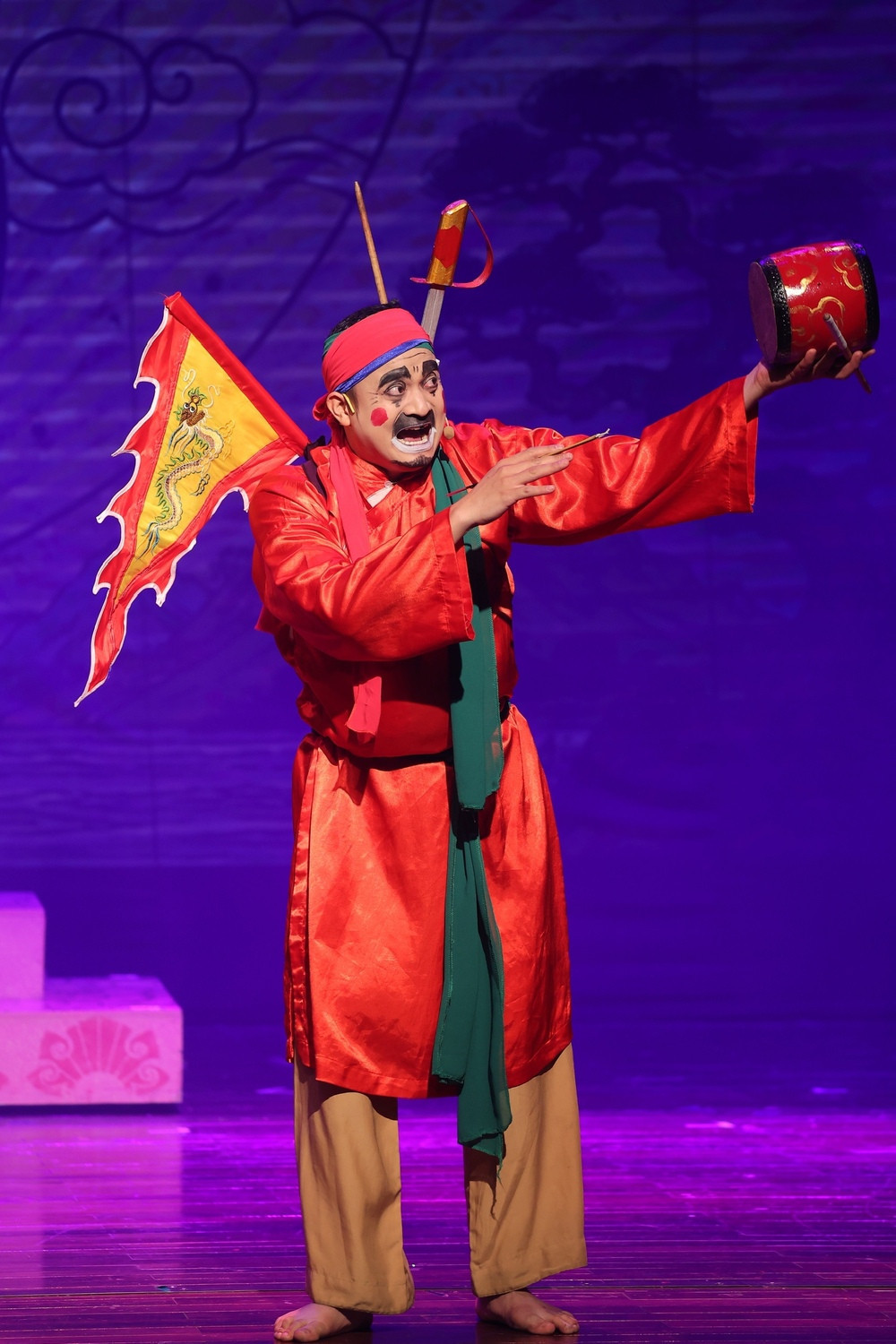
Illustrative image: Youth Theatre.
In the cultural market, the boundary between “drawing inspiration from” and infringing copyright can be extremely thin. Many stage artists and authors have experienced the frustration of seeing their creative works cut, reworked or adapted into other formats without receiving any additional payment.
To better protect artists’ interests at their source, Decree 287 has been closely aligned with the amended Intellectual Property Law, clarifying the distribution of royalties among four parties: authors, copyright owners, performers and owners of related rights.
According to lawyer Hoang Ha of the Ho Chi Minh City Bar Association, one point deserves particular attention as Decree 287 is put into practice: the interests of everyone involved in creating a work should not simply be grouped together under the general term “royalties.”
A single artistic work may simultaneously involve authors’ rights, copyright ownership, performers’ rights and related rights. Each party’s entitlements arise from different legal grounds and cover different scopes of economic benefit.
“Introducing royalties is a step forward, but what matters even more is identifying who is entitled to the money, which right gives rise to that payment and at what stage it should be paid. Unless these points are clearly established in the contract from the outset, disputes may still arise when a work is rebroadcast on television, distributed on digital platforms, adapted or commercially exploited,” Ha said.
He argued that contracts should now go well beyond specifying a single lump-sum fee. They need to clearly define which rights are transferred, the scope of use, duration, territory, distribution platforms, adaptation and sublicensing rights, methods for calculating revenue and profit, and mechanisms for verifying financial figures.
Ha also cautioned against interpreting incentive royalties derived from profitable commercial exploitation as making creators “shareholders” in the legal sense. These are economic benefits arising under the decree and agreements between the parties; they do not alter capital ownership or a creator’s legal status within the organization exploiting the work.
“Transparency over rights from the very beginning will determine whether Decree 287 genuinely protects creators or merely becomes another new payment schedule,” Ha said.
He warned that while policy may have changed, implementation could remain trapped in the old mindset. If royalties increase and creators become entitled to a broader share of economic benefits, but budgeting still requires multiple layers of approval, payments remain slow, supporting documentation is cumbersome, profits are not disclosed or every payment must pass through a lengthy process, the practical benefits for creators will be significantly diminished.
For creative professionals, value lies not only in the amount of money ultimately received, but also in knowing what they are entitled to and when they will receive it.
A talented director, playwright or performer is unlikely to feel confident joining a state-funded project if they know they have rights but cannot tell when they will be paid, how revenue will be calculated or whether administrative procedures will take months to complete.
Ha therefore argued that the new royalty framework must be accompanied by reforms to budgeting, project acceptance, accounting, financial settlement and payment procedures.
If “new payment levels” still have to pass through “old procedures,” he said, it will be difficult for the policy to compete with the private sector in attracting and retaining creative talent.
The decree has now laid out the framework. Artists, for their part, need to recognize that every note they play, every movement they perform and every line they deliver is intellectual property - and that their contracts must therefore be precise, comprehensive and clear.
Tinh Le
.svg)
