 Vietnamnet.vn

 Podcast



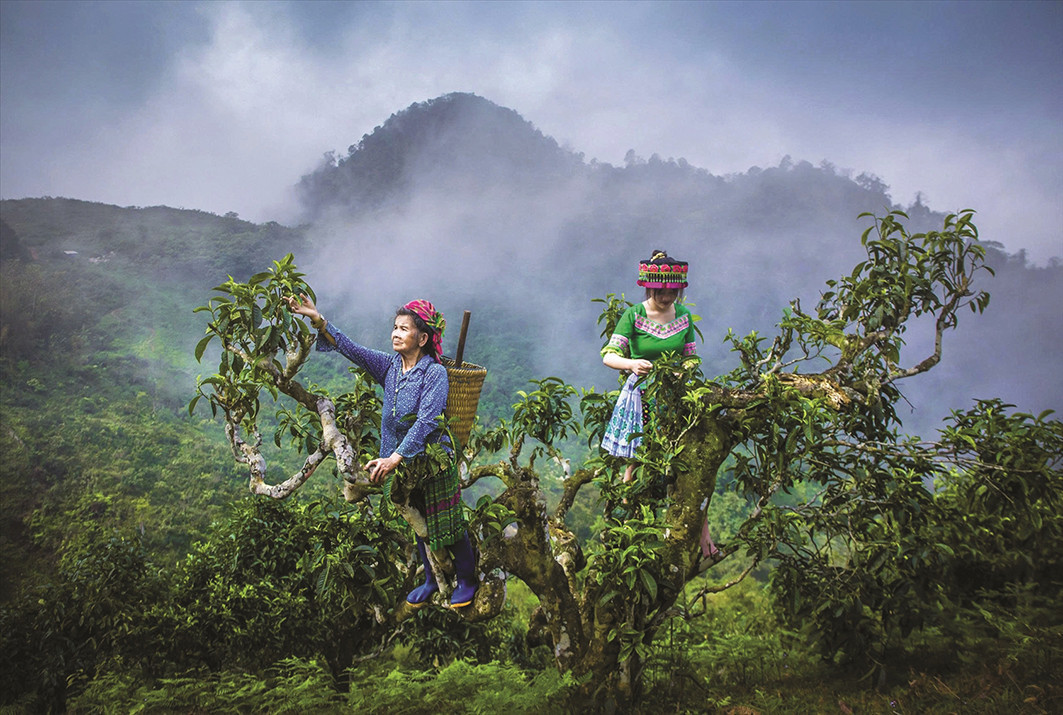
At dawn, clouds blanket the mountaintops. Cold winds weave through ancient tea trees, their rough trunks cloaked in moss. Tender buds, still damp with dew, release a faint, earthy aroma into the crisp air. The Mong people here are accustomed to harsh winds, to snow-covered slopes, and to the crackling sound of firewood in wooden homes when winter settles in.
Beside a glowing stove, in a thin veil of smoke, Giang A Ho, 73, speaks slowly, his voice low like mountain fog: tea is the breath of the village, the soul of the Mong people in Giang Pang.
Sitting across from him, listening to the fire snap and hiss, I ask why, amid such unforgiving terrain, the Mong have chosen tea as their anchor. He gazes into the flames for a long moment, then smiles: “Wherever the Mong go, we look for land with water, forests and clouds. Here in Giang Pang, the land chose the people first, and only then did the people choose tea to live by.”
In that moment, I understand that the story of tea is not told merely in words, but in entire lifetimes bound to the mountains.
More than a century ago, a group of Mong people left Sung Do in the former Van Chan district, crossing mountains in search of new land. They brought with them Shan Tuyet tea varieties from Suoi Giang. At an elevation nearly 700 meters higher than Suoi Giang, Giang Pang remains cold year-round, often blanketed in snow. The tea buds grow slowly, preserving their signature silvery fuzz - a flavor that, even after a century, is regarded as the “green gem” of the mountains.
In the early days, tea grew wild and unattended. Some winters were so harsh that snow turned leaves pale and lifeless, killing entire trees. Villagers abandoned the crop to clear other fields. But one day, seeing how people in Suoi Giang lived off tea, the people of Giang Pang returned. They cleared grass, pruned branches, nurtured the roots and revived the tea trees. From then on, the Mong here settled permanently among the Shan Tuyet hills.
Evening falls quickly in Giang Pang. As the cold mist thickens along narrow paths, I make my way to the home of elder Giang A Ho, nearly 80, affectionately known as the village’s “living tea repository.” Bent over a blackened iron pan, his hands tremble with age yet remain deft as he stirs the tea leaves. Firelight flickers across his weathered face.
“The tea tree is like a person,” he says, lifting his head. “It must endure wind and frost to keep its fragrance.”
When asked how tea was made in the past, he smiles, eyes half-closed as if turning the pages of memory. “We picked the leaves, rolled them by hand, then dried them under the sun. The stronger the sun, the redder and more astringent the tea. It was bitter, but it warmed the body. Tea kept us through snowstorms and was what we offered to guests from afar. Now machines help, but the mountain’s aroma remains unchanged.”
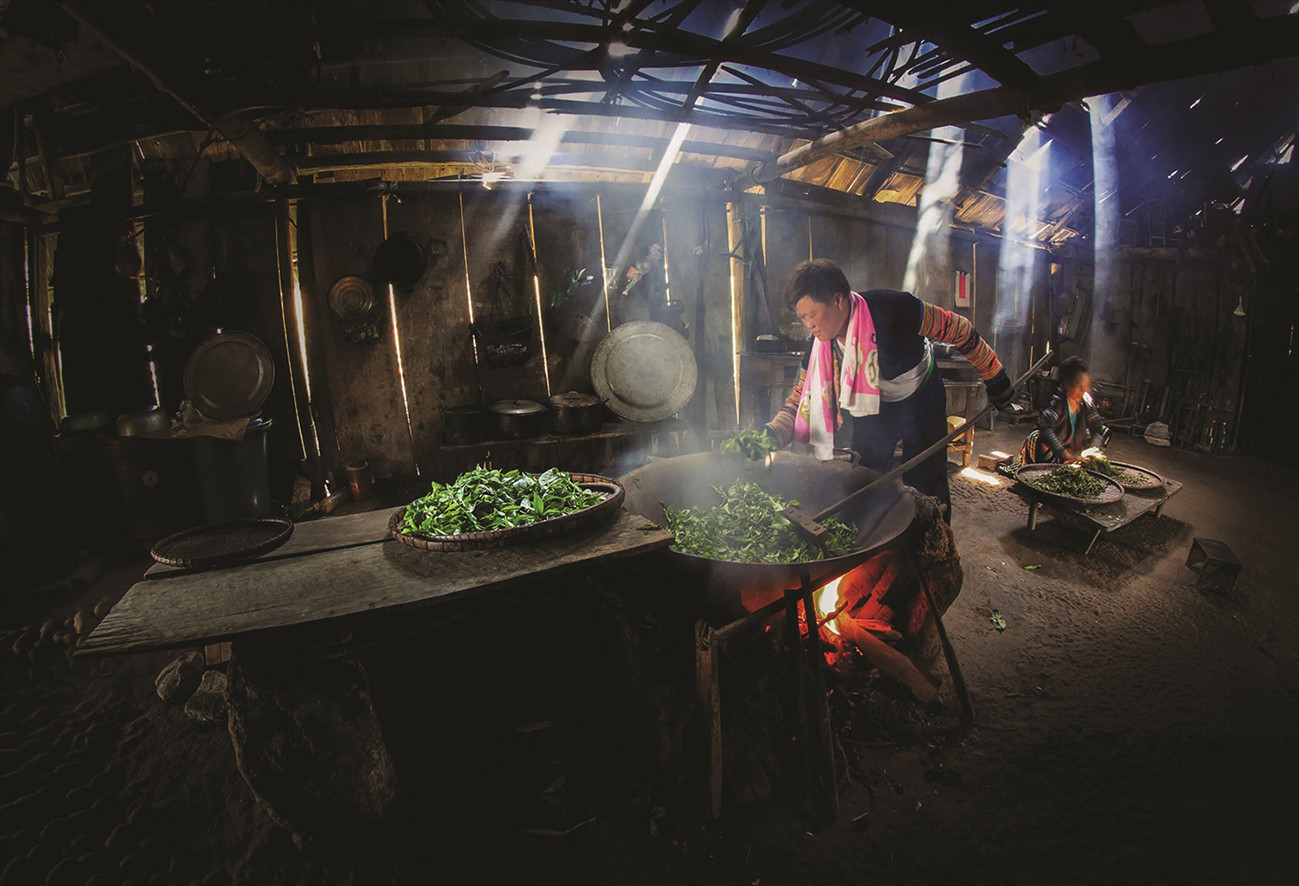
Traditional tea roasting process in the highlands.
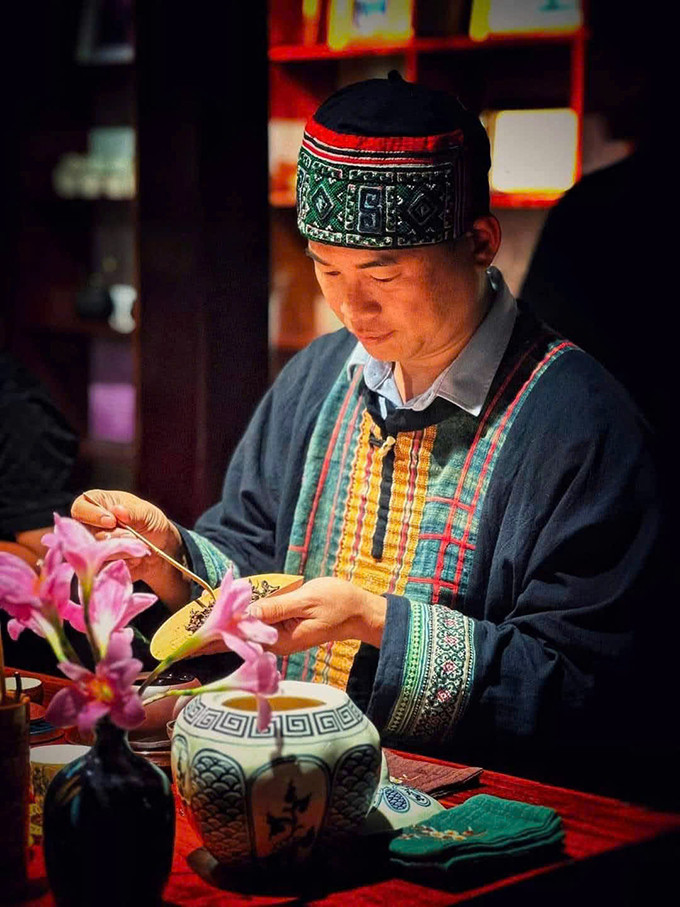
His words linger in the smoke-filled kitchen like the aftertaste of old tea. Stepping out of those memories, I encounter a Giang Pang in transition. The buds still come from high mountains, the forest scent unchanged, but the hands that shape them are younger, and the rhythm of tea-making has shifted. A new generation is quietly continuing the old story in new ways.
Inside a workshop filled with the scent of fresh leaves, Giang A Cu, around 30, adjusts a batch of drying tea and turns to me with bright eyes. “In the past, tea sold for just VND100,000 per kilogram (US$4). Now green tea is around VND400,000 (US$16), and specialty varieties can exceed VND3 million (US$120). We can stay here, make tea and do tourism without leaving our village.”
Mua Thi My, a young woman with luminous eyes, adds: “I learned tea roasting techniques in Yen Bai. Now we make clean tea, without chemicals. I want people from the lowlands - and even abroad - to remember Giang Pang tea once they taste it.”
The hum of drying machines blends with the laughter of young villagers, softening the chill of the mountain afternoon. I jokingly ask whether they still drink sun-dried, hand-rolled tea like their elders.
“Of course,” Giang A Lenh replies with a grin. “But now we use machines and controlled heat, so the color is clearer and the taste smoother. Some places even order mold tea or tea cakes like in China and Taiwan. Buyers come all the way here to try. Giang Pang tea now has QR codes and is already exported abroad.”
Amid the steady rhythm of machines and youthful voices, it becomes clear that while the story of tea has turned a new page, its roots remain deeply anchored in the clouds and mountains of Giang Pang. Where once tea was sun-dried and sharply bitter, modern processing now preserves its green hue, gentle astringency and lingering sweetness without losing its forest essence.
From this remote highland, Shan Tuyet tea has reached China, Taiwan, Japan, South Korea, the Middle East and Europe. Hands once rough from shifting cultivation now move with ease between iron pans and drying ovens. A traditional craft has found new life through knowledge and innovation.
As dusk thickens, mist pours over the hills. Walking back to the village, I am joined by Trinh Xuan Thanh, Party Secretary of Son Luong commune, who has long been connected to Giang Pang. Having worked in various tea regions such as Suoi Giang, Phinh Ho and Ta Sua, he reflects on what sets this place apart.
“Giang Pang tea has a unique flavor,” he says slowly. “Rich yet refined. It carries the altitude, the mist and the hands of the Mong people.”
I ask, half in jest, whether a “green revolution” is unfolding here.
He smiles, gazing toward the tea-covered hills fading into the mist. “Perhaps. But the essence lies in the people’s awareness. They are the ones who preserve the soul of the mountains in each bud, no matter how modern the technology becomes. The government supports, creates mechanisms and opens pathways, but the spirit of the tea remains in the hands of the people.”
After a pause, he adds, his voice firm: “Giang Pang tea is now exported to many countries. But what matters most is that the Mong people are building prosperity on their own land, without losing their culture or leaving the mountains.”
The people of Giang Pang are not merely preserving tradition. They are forming groups, establishing cooperatives and building production chains that are clean, standardized and sustainable, ensuring that tea not only thrives on the hills but stands strong in the market.
Inside the tea workshop, Mua Thi My, director of the Sung Do Agro-Forestry and Community Tourism Cooperative, pours a pot of white tea and shares with quiet pride: “We sell to Cao Tra Muc Nhan Company for export to China. Each year, our cooperative produces over one ton of white tea, nearly 500 kilograms of raw black tea and more than one ton of green tea. It is hard work, but it is rewarding because our tea is more widely known, sells at better prices and allows people to live from their own land.”
Giang A Ly, owner of the village’s first tea workshop, adds: “We produce white, black, green and raw Pu-erh tea. Giang Pang tea has been introduced in China, France, Germany and the Czech Republic. To compete, it must be clean and meet standards. We used to sell mainly to China, about 7 to 8 tons a year. This year, as imports paused, we shifted to the domestic market and Europe.”
Giang A Lenh, a young man selling tea through social media, laughs: “I produce about 300 to 500 kilograms a year. Customers from the US like Stever Shafer and Anna Ye order regularly. In Japan, Keko helps promote our tea.”
From bamboo trays of sun-dried leaves laid out in front of wooden homes to modern drying systems, from tea carried on the backs of villagers to weekly markets to shipments crossing oceans to the US, Japan and Europe, the journey of Giang Pang tea reflects a community that learns, adapts and evolves without losing itself.
In the drifting mist of late afternoon, the sound of tea roasting mingles with the scent of early spring. Amid the vast clouds of Giang Pang, the Shan Tuyet buds continue to sprout - carrying with them a quiet, enduring ambition.
Dang Phuong Lan
.svg)
