 Vietnamnet.vn

 Podcast


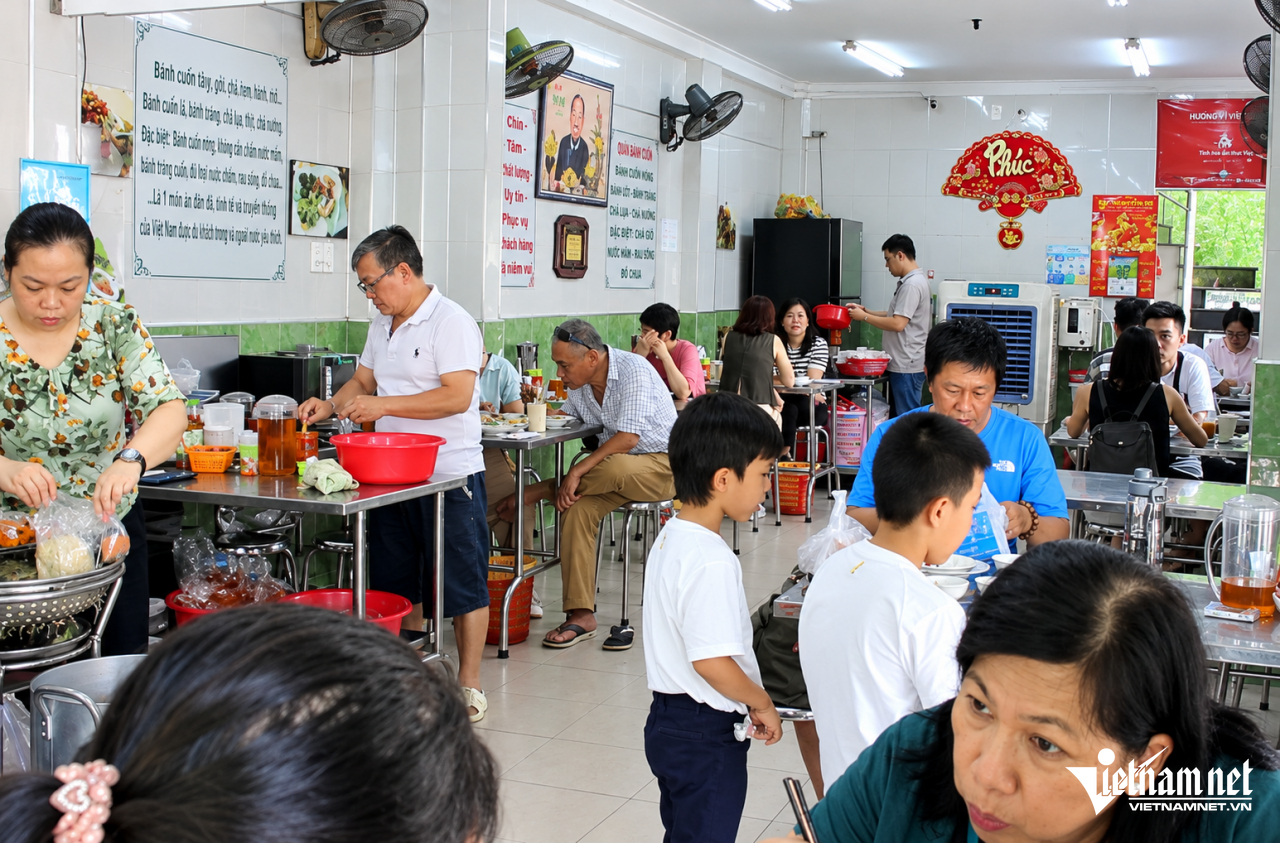
On a weekend morning, Lan, 66, who lives in the former District 7 of HCMC, took a ride from home to Tay Ho Banh Cuon Shop in Tan Dinh Ward to enjoy a familiar dish. She has been a regular customer since the 1980s.
For her, the eatery is part of her youth and cherished memories. Although she no longer lives nearby, she still visits whenever she gets the chance.
Not far from Lan's table sat Tuyen, born in 1984, and her Singaporean friend Carmen, born in 1985. Tuyen had also known about the banh cuon shop for many years.
"This banh cuon shop has been famous for a long time. The rice rolls are delicious, and the dipping sauce suits my taste. Carmen also likes Vietnamese banh cuon and banh gio (Vietnamese pyramid rice dumpling). Whenever we have the chance, I bring her here to eat banh cuon," Tuyen said.
Tran Thi Thuy Loan, born in 1974 and the shop's owner, said the business was opened in 1961 by her late mother-in-law, Tran Thi Ca. Initially, Ca sold banh cuon from a roadside stall beside the Phan Chau Trinh memorial temple on Gallimard Street, now Nguyen Huy Tu Street in the former Da Kao Ward of District 1, HCMC.
Loan explained: "Phan Chau Trinh (an early 20th-century Vietnamese nationalist and reformer) went by the pen name Tay Ho, often called Phan Tay Ho, so customers visiting the stall naturally nicknamed my mother-in-law's stall 'Tay Ho Banh Cuon' for easy reference. Finding the name meaningful, my mother-in-law adopted it for the eatery.
Later, when relocating to the current spot, the eatery retained its original name. As my mother-in-law advanced in age, my family and I took over operations. For the past 3 years, I have been the primary manager."
For decades, Loan has preserved the traditional preparation formula handed down from Ca's era. The steamed rice rolls are made from rice flour batter, wrapped around fillings of minced pork, cassava, and wood ear mushrooms.
Today, to cater to diverse customer tastes, beside traditional banh cuon, Loan prepares additional variants filled with pork, shrimp, and mushrooms; chicken and mushrooms; pork floss; or shrimp floss.
The menu also offers a variety of vegetarian banh cuon options, including mixed mushroom, lotus seed, and bean fillings; pandan-infused rice rolls with vegetables and tofu; as well as lingzhi mushroom fillings.
In June 2026, Tay Ho Banh Cuon was recognized by the Michelin Guide in the Bib Gourmand category (quality cooking at affordable prices).
According to Michelin, the banh cuon features a thin, delicate, and soft outer skin. Ingredients are prepared adjacent to an open kitchen, offering balanced traditional flavors with pork, cassava and vegetarian choices.
The eatery opens daily from 5:30 AM to 9:30 PM. Depending on the chosen fillings, portions range from VND40,000 to VND72,000 per serving.
Dressed in Ao Dai to welcome guests
Offering delicious rice rolls and a diverse menu, Loan's eatery stays constantly bustling with customers. Evolving from a nameless roadside stall into a famous two-story establishment, it has won the hearts of domestic and international visitors.
“Many customers have dined at the eatery since Ca ran the stall. Today, they return with their children to enjoy the dish intertwined with their childhood memories.
The establishment also attracts foreign tourists, particularly after being recognized by the Michelin Guide. Previously, to serve international guests better, I attended language classes every evening after finishing work at the stall,” she said.
In addition to serving delicious banh cuon, Loan's establishment stands out due to her unique hospitality practice. Every day when arriving to steam rice rolls for patrons, Loan greets guests with a bright smile while wearing a traditional ao dai.
The colors and decorative patterns on her ao dai change daily; she rarely repeats a color scheme within the same week.
Explaining her choice, she said: "I believe one doesn't need to attend a party or go out on the town to dress nicely; even when selling banh cuon, presenting oneself neatly and elegantly reflects respect toward customers.
Banh cuon is a traditional dish, and ao dai is traditional attire. I choose to wear ao dai while preparing banh cuon both to honor my guests and to promote the cultural beauty of our country,” she said.
Ha Nguyen

