 Vietnamnet.vn

 Podcast



From simple preservation to preservation linked with development
On the morning of April 17, the Ministry of Culture, Sports and Tourism held a national conference to implement ethnic cultural work, combined with honoring village elders, village heads, artisans, and reputable individuals in communities.
Deputy Minister Trinh Thi Thuy emphasized that during the 2021–2025 period, under the leadership of the Party and the administration of the Government, particularly through the National Target Program on socio-economic development in ethnic minority and mountainous areas, ethnic cultural work has achieved many positive outcomes. Institutional frameworks have gradually been improved; many cultural values have been preserved and restored; and models linking preservation with tourism and livelihoods have begun to show effectiveness. Notably, the mindset has shifted from simple preservation to preservation associated with development.
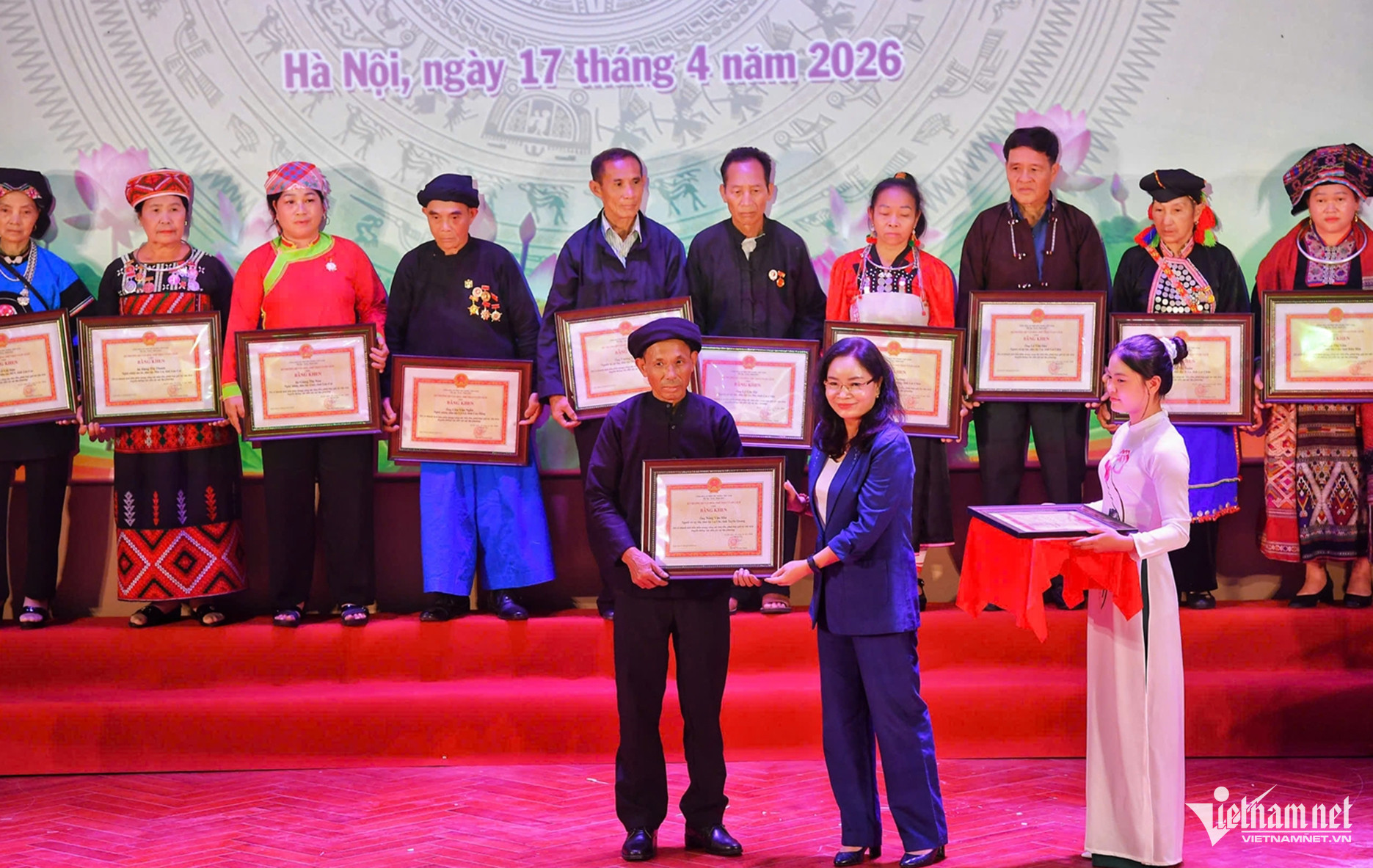
Over the past five years, many key tasks have been implemented effectively, especially Project 6 under the National Target Program. Numerous villages have been restored and preserved, contributing to improved living standards and promoting local socio-economic development.
Significantly, development thinking has undergone a clear transformation - from “simple preservation” to “preservation linked with development,” gradually harnessing cultural values to create livelihoods and improve people’s lives. The role of communities, particularly artisans, village elders, village heads, and reputable individuals, has been increasingly affirmed and promoted.
During the 2021–2025 period, 45 models of traditional cultural preservation linked to tourism were established and operated; more than 20 folk culture clubs were formed; 30 research programs on safeguarding intangible cultural heritage were implemented; over 60 training courses were organized; 3,220 cultural houses and sports areas were built or upgraded; 69 tourist sites were invested in; and 48 traditional cultural villages were developed in association with preserving cultural spaces and promoting tourism.
Addressing bottlenecks, preserving heritage from local realities
Despite these achievements, Deputy Minister Trinh Thi Thuy acknowledged several limitations, including inconsistent mechanisms and policies, slow disbursement, some unsustainable models, limited digital transformation, and weak grassroots human resources. These are “bottlenecks” that require timely and practical solutions.
Dinh Van Tuan noted that Lam Dong is a land rich in distinctive traditional cultural values, highlighted by a system of intangible heritage such as gong culture, folk songs, folk dances, customary laws, and traditional rituals and festivals.
However, he pointed out that organizing festivals among ethnic minority communities still faces many challenges. The impacts of the market economy and integration have eroded traditional cultural environments. Many rituals and festivals are gradually disappearing, artisans are becoming fewer, and some community members no longer participate in folk beliefs.
He also observed that changes in livelihoods have led to the decline of agricultural rituals and traditional beliefs, posing risks to the cultural space of gong heritage. Preservation efforts remain heavily dependent on the State, with limited community initiative; some festivals have been staged in ways that dilute their authenticity; and investment and research resources remain constrained.
From this reality, Dinh Van Tuan proposed strengthening state management alongside greater community participation; promoting preservation, transmission, and education; organizing festivals in line with authentic traditions; mobilizing social resources; investing in cultural infrastructure; and enhancing coordination, research, and restoration of traditional festivals.
Sharing the same view, Lai Vu Hiep, Deputy Director of the Lao Cai Department of Culture, Sports and Tourism, affirmed that the cultural heritage of ethnic minorities is an invaluable national asset and a source of strength for national unity. He suggested continuing to allocate resources for the National Target Program and Project 6 in the next phase, and organizing training early to ensure synchronized implementation across localities.
He also recommended mechanisms to encourage socialization, creating conditions for artisans to practice and pass on heritage; promoting digital transformation linked to community tourism promotion; and expanding regional linkages so that localities can exchange experiences and replicate effective models.
Concluding the conference, Deputy Minister Trinh Thi Thuy outlined key solutions, focusing on improving institutional frameworks and policies as a breakthrough step; developing specific mechanisms to support cultural development, artisans, and heritage preservation while mobilizing social resources; enhancing the effectiveness of National Target Programs with a focused approach; linking cultural preservation with tourism and livelihoods; emphasizing transmission to younger generations; and developing cultural industries and community tourism to transform cultural values into products, creating jobs and increasing incomes for local people.
Thuy Hong
.svg)
