 Vietnamnet.vn

 Podcast



Men men is a traditional dish made from local non-glutinous corn and is a daily staple of the H’Mong ethnic people living in the mountainous regions of Northwest Vietnam.
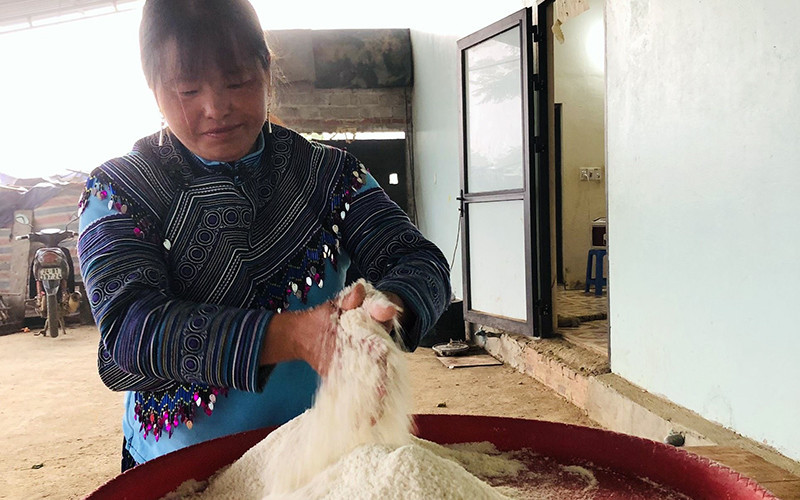
The process of making men men begins with selecting the best corn kernels - plump, whole, and free of mold or pests. The chosen kernels are then ground into fine cornmeal.
In many areas, the H’Mong still use traditional stone grinders - heavy, hand-operated mills made of two stacked circular stones.
After grinding, the cornmeal is sifted to remove husks and grit, then lightly moistened and placed into a flat bamboo tray for mixing.
Steaming men men is a meticulous two-step process. In the first round, the moistened cornmeal is placed into a bamboo steamer (cho), sprinkled with a bit more water, and gently stirred to ensure the grains remain loose and do not clump together.
In the second round, the mixture is steamed more thoroughly until the texture becomes tender, sticky, and fragrant with a bright yellow hue.
Trang Thi Pla, who has been cooking and selling men men at the Can Cau market in Si Ma Cai (Lao Cai Province) for nearly 20 years, shares her tip: “You have to carefully calculate the amount of water to avoid the cornmeal being too dry or too clumpy. If it’s too dry, it won’t cook through; if too clumpy, the dish will fall apart and lose its flavor.” This is why the task of preparing men men is often reserved for experienced cooks in the family.
Men men has a soft, nutty flavor and a rich aroma. It is best enjoyed hot. A small portion eaten with soup enhances its savoriness - the more you chew, the sweeter and more flavorful it becomes.
At traditional highland markets, the H’Mong often eat men men with pho broth, thang co (horse stew), bean soup, fermented bean paste, or chili sauce.
With the rise of tourism in mountainous regions, men men has been added to the menus of many hotels and restaurants, becoming a local specialty for visitors to enjoy.
Though modern life has brought more abundance to the H’Mong, and rice has become more common in their main meals, men men remains a spiritually significant food.
During festivals, funerals, weddings, and especially during Tet (Lunar New Year), men men is a sacred offering placed on ancestral altars as a symbol of reverence and gratitude.
PV
.svg)
