 Vietnamnet.vn

 Podcast



At the age of 83, Meritorious Artisan Ho Van Dinh continues to quietly preserve the distinctive cultural traditions of the Ca Dong people, a subgroup of the Xo Dang ethnic community. His eyes still light up whenever he speaks about village festivals or the echoing sounds of gongs across the mountains.
Gong rhythms echo through the clouds
The journey to Ho Van Dinh's home in Hamlet 5 of Tra Doc Commune, Da Nang City, is far from easy.
From the Song Tranh reservoir, visitors must travel by boat across deep green waters before making their way along winding rocky slopes to reach the stilt house nestled against the mountainside.
Mountain mist drifted across the late afternoon landscape. Smoke from the kitchen fire curled gently from the roof of the old wooden house. The elderly artisan, his hair completely white and his beard long and silver, stepped out to greet visitors with a warm smile.
Inside the house, filled with the scent of wood smoke, sets of gongs, drums and bamboo baskets hung neatly along the wooden walls. The space felt like a small sanctuary preserving the memories and traditions of the Ca Dong people.
Even at 83, his eyes sparkle with enthusiasm whenever he talks about village ceremonies or the sounds of gongs resonating through the forests.
As if worried that those memories might one day disappear, he carefully pulled out an old notebook with worn edges from beside his bed.
Its pages were filled with handwritten notes and illustrations depicting ceremonial poles, gong sets, bamboo baskets and traditional rituals. He turned each page gently, as though revisiting the story of his entire life.
"I write these things down so future generations will understand the culture of our people. Every ethnic group has its own way of making ceremonial poles, playing gongs and conducting rituals. If we do not record them, young people may forget," he said softly.
Moments later, Dinh walked over to a set of gongs hanging on the wall.
His slender hands moved deftly as he adjusted each instrument, like a musician preparing to take the stage. The sounds that followed filled the stilt house on the mountainside - at times gentle like a stream flowing over rocks, at others vibrant like dancers celebrating a new rice harvest festival.
Blending with the sound of rain falling outside, the music seemed to suspend time itself.
Because of his deep knowledge of gong culture, K'cheo folk singing and traditional ceremonies, residents of the former Bac Tra My area have long referred to him as a "multi-talented village elder."
In recognition of his decades of dedication, he was awarded the title of Meritorious Artisan in 2019.
In a wooden room behind the house, certificates and commendations cover the walls, quietly telling the story of a lifetime devoted to preserving Ca Dong culture.
The keeper of mountain melodies
Ho Van Dinh's dedication extends far beyond traditional gong music.
He is also among the few remaining people in Tra Doc who continue practicing the traditional bamboo and rattan weaving craft of the Ca Dong community.
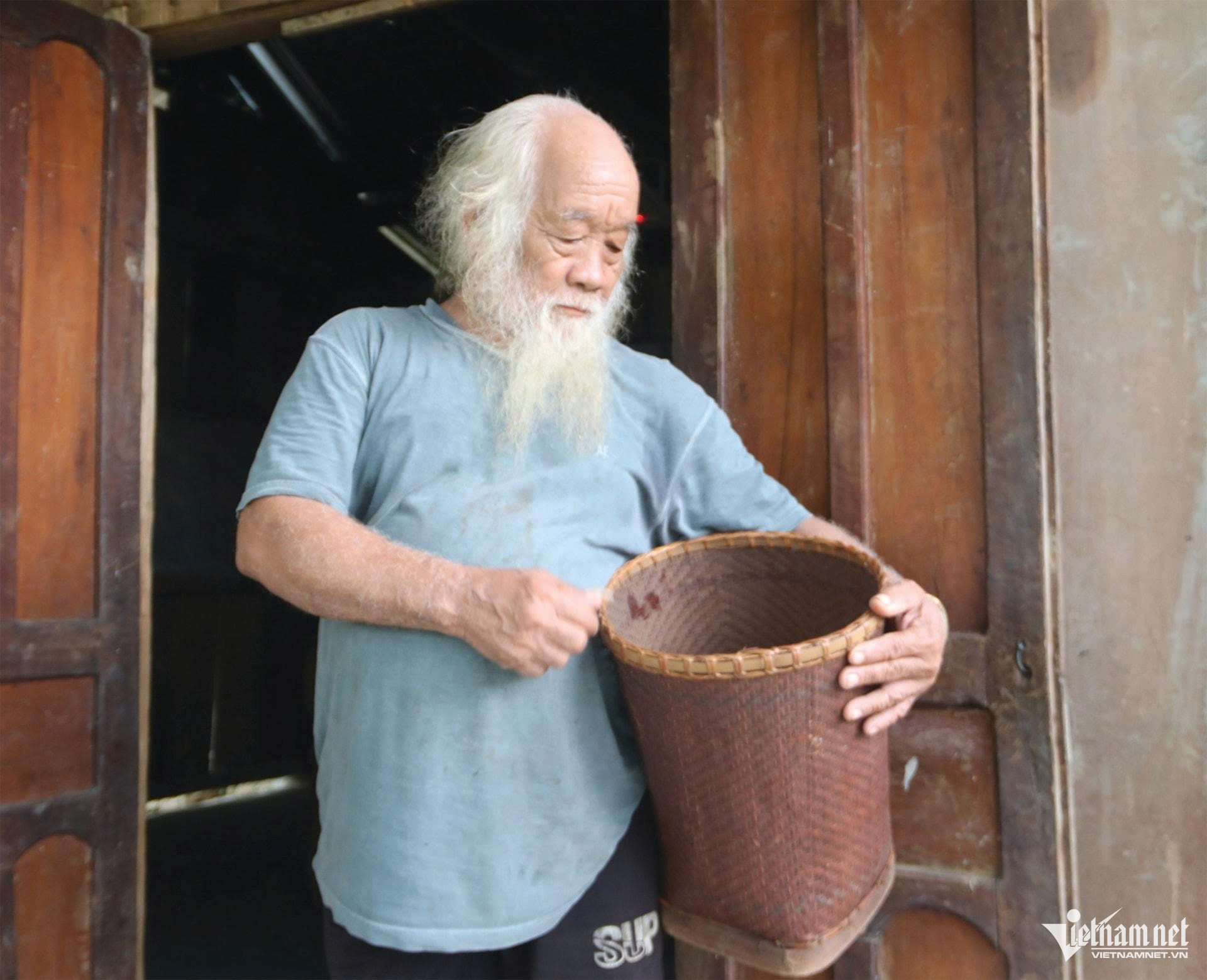
During quiet afternoons, he often sits outside his home splitting bamboo and rattan strips to weave baskets and carrying packs. His weathered hands still move with remarkable speed and precision, guided by skills refined over decades.
He proudly showed visitors a carrying basket he had completed only days earlier.
Outside, rain blurred the surface of the Song Tranh reservoir.
"It took nearly a week to finish this basket. Finding quality rattan is much harder now, and traveling into the forest is more difficult. But whenever I start weaving, I become completely absorbed in it. I cannot stop," he said.
In the past, the Ca Dong people relied almost entirely on items made from bamboo and rattan.
Carrying baskets for rice, storage containers and bamboo trays used in daily meals were all handcrafted by villagers. According to Dinh, nearly everyone once knew how to weave.
Both young men and women could make their own baskets for personal use or as gifts for family members.
"Nowadays there are plastic and metal products everywhere, so fewer people are interested in learning the craft. If we do not preserve it, one day nobody will even know what a traditional Ca Dong basket looked like," he reflected.
Perhaps it is precisely this concern over the gradual disappearance of traditional culture that has motivated him to continue the craft for so many years.
As long as he is able, he says, he will continue passing on his knowledge to younger generations.
At community gatherings in Tra Doc, the sight of the white-haired artisan enthusiastically teaching gong rhythms and traditional dances has become familiar to local residents.
For many years, he has been invited to teach traditional cultural practices in schools and train youth gong ensembles throughout the mountainous areas of the former Bac Tra My district.
As evening falls over the stilt house perched on the mountainside, Ho Van Dinh remains quietly seated beside his cherished set of gongs.
With unwavering devotion and persistence, the elderly artisan continues his silent mission to ensure that the sounds of the mountains never fade amid the changes of modern life.
Huy Truong
.svg)
