 Vietnamnet.vn

 Podcast



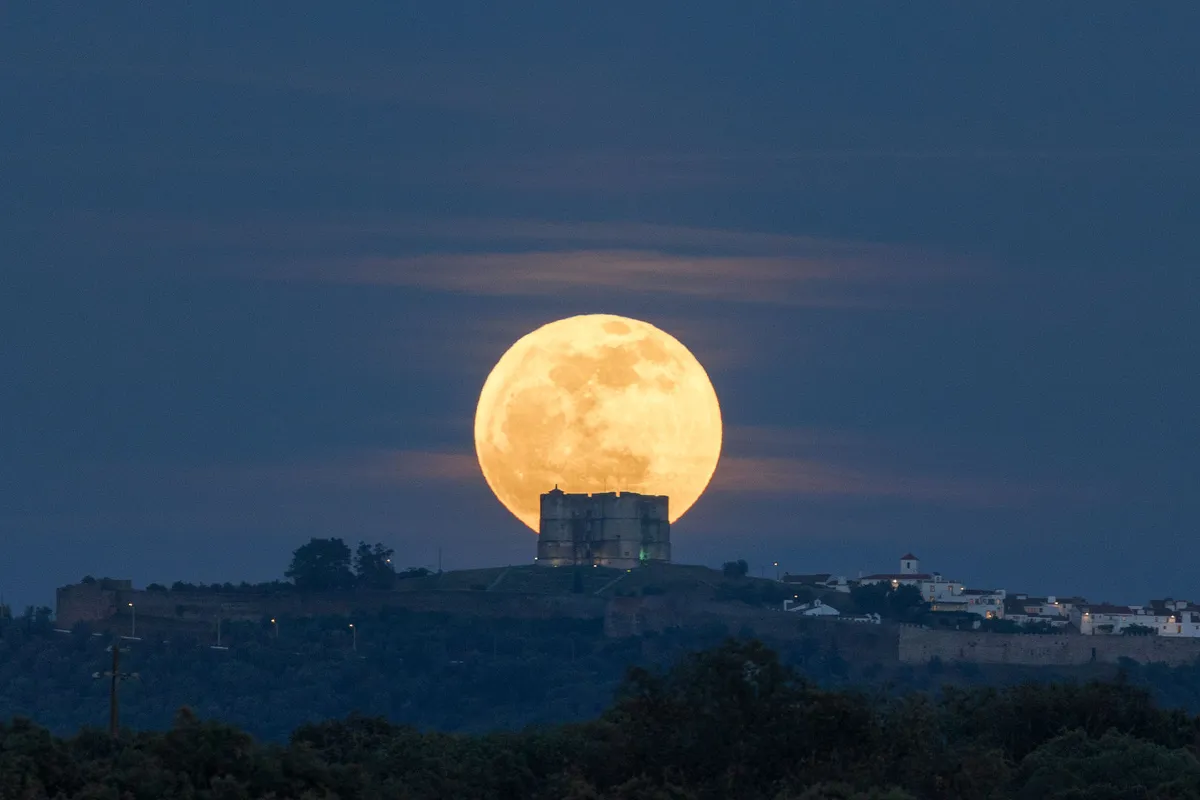
From Earth, we seem to see the same "face" of the Moon all the time. No matter when we look during the year, its phases may shift from crescent to half-moon to full moon, but the distinctive craters, bright regions and dark patches on its surface remain largely the same.
For thousands of years of recorded history, this familiar pattern of bright highlands interspersed with vast dark plains, known as lunar maria, has remained turned toward Earth. It is a sight that virtually every generation of humans to have lived on our planet has been able to see with the naked eye.
That raises an intriguing question: Earth spins on its axis and the Moon travels around Earth, so why don't we eventually see its entire surface?
The answer lies in an important phenomenon of celestial mechanics known as tidal locking.
The Moon rotates - at exactly the right rate
A common misconception is that the Moon does not rotate. In fact, it does spin on its own axis.
What makes it unusual is that the Moon completes one rotation in about 27.3 days, almost exactly the same amount of time it takes to complete one orbit around Earth.
That synchronization is what keeps nearly the same lunar hemisphere facing us.
There is a simple way to picture it. If the Moon did not rotate as it traveled around Earth, we would gradually see every part of its surface over the course of one orbit. Likewise, if it rotated faster or slower than it does today, the part facing Earth would continually change.
But because the Moon's rotation and orbital motion are synchronized, every time it completes one orbit around Earth, it also completes exactly one rotation on its axis. The result is that nearly the same side remains turned toward our planet.
Astronomers call this state tidal locking.
Saying that we can see exactly 50% of the Moon's surface, however, is not entirely accurate.
Because of a slight apparent rocking motion called libration, observers on Earth can peek a little beyond the Moon's edges at different times. Over time, this allows us to see about 59% of the lunar surface.
Earth's gravity slowed the Moon's rotation
To understand why the Moon became tidally locked, we need to go back to its early history, about 4.5 billion years ago.
The young Moon rotated much faster than it does today. But Earth's powerful gravitational pull continually acted upon its natural satellite.
Just as the gravitational forces of the Moon and Sun produce tides in Earth's oceans, Earth's gravity also caused tiny but important deformations in the Moon.
Put simply, the Moon is not a perfect sphere. Differences in gravitational pull created a slight bulge along the line connecting Earth and the Moon.
When the Moon was rotating more rapidly, the position of this deformation did not remain fixed but continually shifted across its surface. That movement generated internal friction within the Moon, gradually dissipating its rotational energy.
Over time, the effect acted like an enormous natural brake, slowing the Moon's rotation.
After billions of years, the process eventually brought the Moon into an equilibrium in which the time required to rotate on its axis matched the time required to orbit Earth.
Once that state was reached, the hemisphere facing Earth became almost fixed in place. That is why people on Earth still see the same familiar side of the Moon today.
Tidal locking is far from rare in the universe. Many other natural satellites are tidally locked to the planets they orbit.
Earth itself is also affected by the Moon's tidal forces, causing our planet's rotation to change extremely slowly over geological timescales.
So why does the Moon change shape from night to night?
Although the same side of the Moon remains turned toward Earth, its appearance clearly changes from one night to another. Sometimes we see only a thin crescent. It then grows toward a half-moon, becomes full and eventually shrinks again.
This does not happen because the Moon turns a different side toward Earth. It is caused by the phases of the Moon.
A lunar phase is simply the portion of the Moon's sunlit surface that we can see from Earth.
At any given moment, roughly 50% of the Moon's surface is illuminated by sunlight. But from our viewpoint on Earth, we cannot always see all of that illuminated portion.
During a new moon, for example, the illuminated hemisphere is largely facing the Sun and away from Earth, making the Moon nearly invisible to us.
As the Moon continues along its orbit, the angle between the Sun, Earth and Moon changes, allowing us to see an increasingly large portion of its illuminated surface.
At full moon, Earth is positioned roughly between the Sun and Moon, so almost the entire lunar hemisphere facing us is illuminated.
This is also why astronomers do not call the part of the Moon that faces away from Earth the "dark side of the Moon."
The phrase is misleading because that side also experiences day and night and receives sunlight just as the side visible from Earth does. The more accurate term is the Moon's far side.
A complete cycle of lunar phases, from new moon to full moon and back to new moon, lasts about 29.5 days. This period is known as a synodic month.
Hai Phong
.svg)
