 Vietnamnet.vn

 Podcast



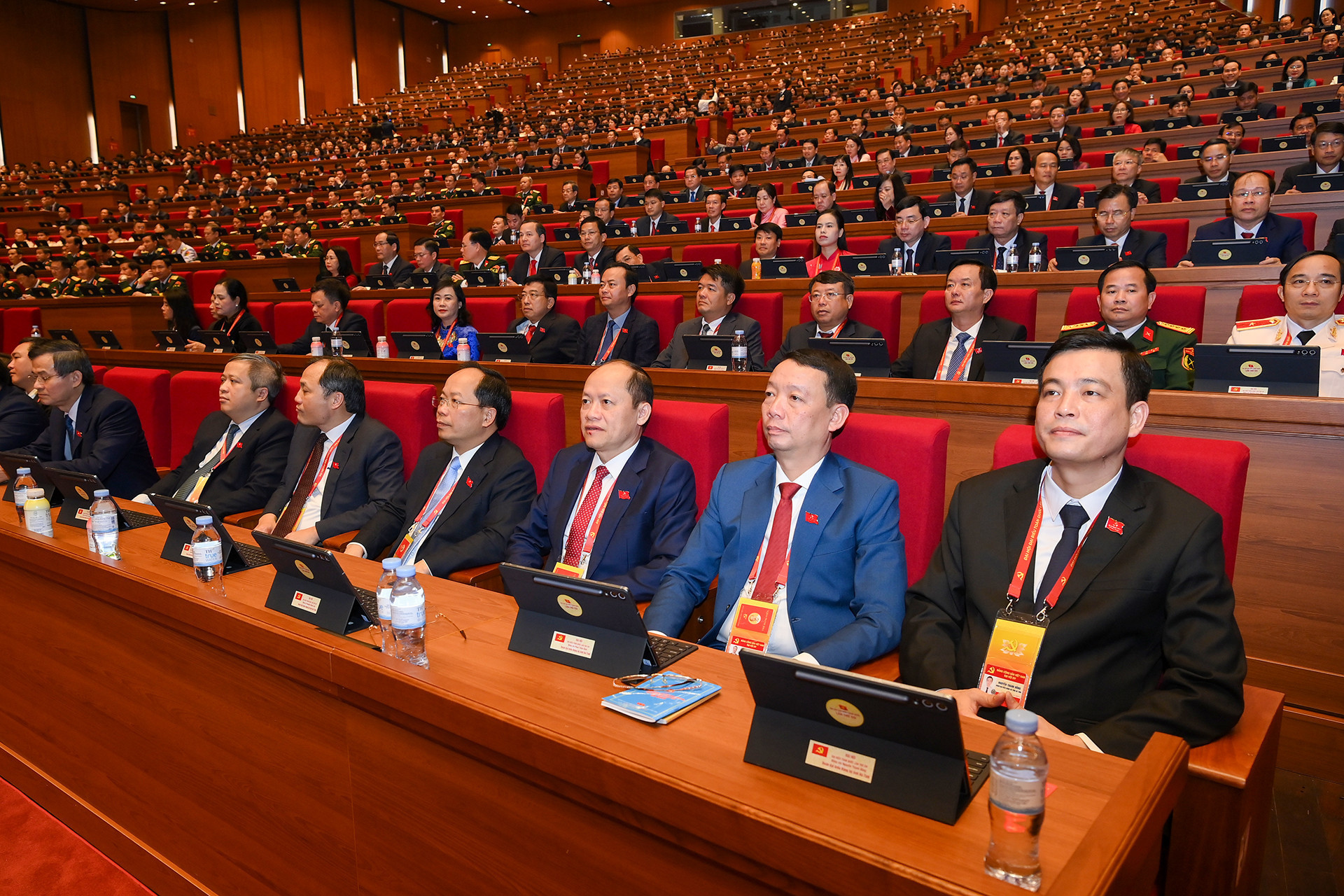
The 14th National Congress of the Communist Party of Vietnam convened at a pivotal moment, as the country enters a new phase of development marked by greater ambition - higher growth targets, deeper reforms, and a demand for a leaner, more efficient state apparatus.
At the heart of this turning point is a powerful message delivered by General Secretary To Lam in his opening speech: “The people are the root” - a principle that must guide and measure every policy and decision.
This declaration signals that 14th Congress is not merely charting the path for a single term. It is recalibrating the standard of governance itself: all power and policy must be justified by the trust and consensus of the people.
What stands out this time is how “The people are the root” is no longer treated as a moral truism, but as a strategic and operational centerpoint. It’s not about which policy is issued faster or more frequently. It’s about whether people’s lives are improved, social trust strengthened, and citizens made to feel respected and protected.
Lessons from history: Trust as strength
Vietnamese history offers sharp lessons on the power of public trust. In the 13th century, when the Mongols threatened the nation, Tran Hung Dao did not focus on fortifications. He simply said that victory came from “unity from top to bottom, the whole nation pulling together.” In essence, the strength of a country begins with its people.
In contrast, at the dawn of the 15th century, reformist Ho Quy Ly - with modern ideas ahead of his time - collapsed within a year despite a strong military and fortified strongholds. As his son Ho Nguyen Trung reflected, “A general fears not battle, only the loss of the people’s support.”
One won because the people stood behind him. The other failed because they didn’t. That rule has never gone out of relevance.
This philosophy was embedded in President Ho Chi Minh’s doctrine of “close to the people,” and now reemerges at the center of 14th Congress official documents - not just in rhetoric, but in practical terms.
When the General Secretary stated that public trust stems not from words, but from deeds - from the integrity of officials, the performance of the state, and fairness in shared benefits - it became clear: implementation is the new benchmark.
Governance as felt, not spoken
Citizens do not read policy resolutions. They experience policy through daily interactions - bureaucratic paperwork, land ownership certificates, school fees, job opportunities, and how they're treated at government offices.
Ultimately, every system boils down to people. “The people are the root” only becomes meaningful when it shapes the behavior of every public servant - from top policymakers to the clerk processing a citizen’s file.
That’s why the call to build a socialist rule-of-law state “of the people, by the people, for the people” is no longer just a slogan.
Reform, disruption, and the price of progress
The current institutional framework has long been seen as a bottleneck. Now, it is also seen as a frontier for breakthrough.
Reform becomes real when the time and cost for citizens and businesses become the main metric. When the “ask-give” mechanism is eliminated, and digitalized public services reduce friction, reform begins to touch daily life.
The sweeping overhaul of the administrative apparatus - including the removal of the intermediate district level - now serves as a critical litmus test.
The proposed two-tier local government model is expected to shorten procedures and speed up decisions, bringing government closer to the people. Provincial-level authorities will focus on strategy and coordination, while communes and wards will gain stronger autonomy to directly handle citizen and business needs, under the principle of “local decision, local action, local accountability.”
Yet meaningful reform does not mean painless change. Many citizens express genuine concerns:
Will ID renewals, land titles, vehicle registrations, and school enrollment for their children be interrupted?
Businesses worry about changes to investment permits, business licenses, tax filings, legal addresses, and compliance costs.
These concerns are legitimate. Without unified coordination and strong implementation capacity, the early phase of reform could lead to delays and unease.
It is precisely here that the “people are the root” principle must be tested in practice:
Will the state anticipate these costs and actively minimize transition burdens for citizens and businesses?
Redefining the role of the state
This institutional reform also opens up a broader conversation: redefining the role of the state in the economy.
So long as the mindset remains that there is “much to distribute,” power will be fragmented and public resources misallocated.
This reform is an opportunity to shift the state toward a role of transparent, fair guidance - empowering the market and the people to unlock their full potential.
From vision to daily life
The “for the people” mindset is reflected not just in speeches, but in specific policies. Hundreds of thousands of substandard homes have been replaced in a short time. Tuition fees have been waived for children from preschool through high school. The private sector is officially recognized as a key engine of economic growth.
These are not just numbers or resolutions. These are decisions that directly affect people’s daily lives.
A policy only lives when it begins with the people, serves the people, and is supported by the people.
The distance that remains
Yet the gap between policy intent and real-life experience still exists. In rural and mountainous areas, poverty and job insecurity remain constant concerns. Land disputes often disadvantage the weak. Small and medium enterprises still struggle against procedural hurdles and tax burdens.
Such realities remind us that social trust cannot be measured by performance reports - it must be felt by citizens through safety, dignity, and opportunity.
The 14th Congress sets a new course for national development. The goals may be higher, and the reforms deeper. But the ultimate measure will remain unchanged: the people’s trust and their ability to partake in the nation’s progress.
History has shown that fortresses can be built quickly, but public trust cannot. Any policy that goes against the people’s will - sooner or later - must pay the price.
To hold the people’s trust is to hold everything. This is not a slogan - it is a historical truth. And it is the foundation on which Vietnam must rise and stand firm in the new era defined by the 14th Congress.
Tu Giang
.svg)
