 Vietnamnet.vn

 Podcast


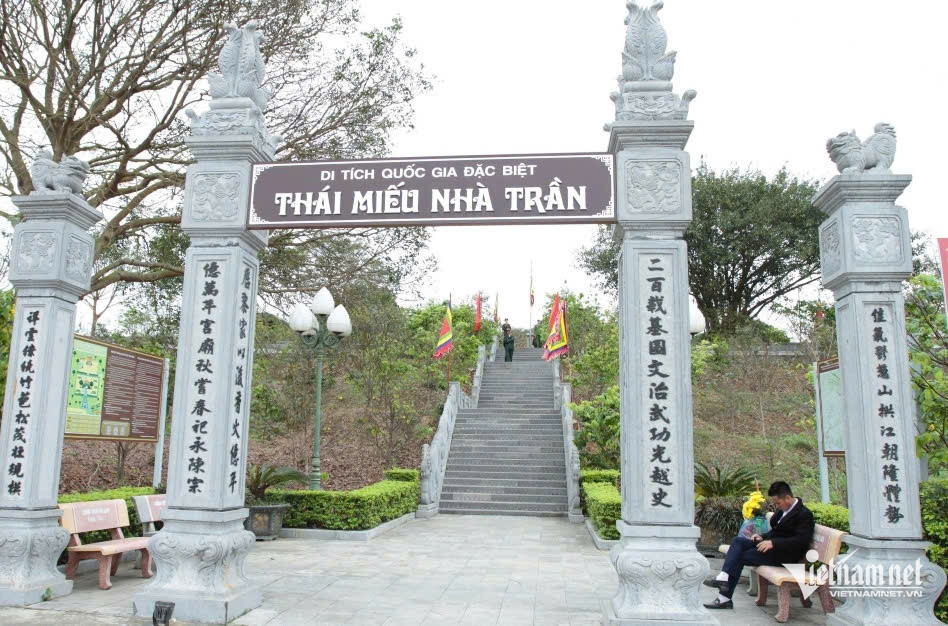
Located in An Sinh Ward, Quang Ninh Province, the Tran Dynasty Ancestral Temple, known in Vietnamese as Thai Mieu nha Tran, is an important spiritual landmark in the former Dong Trieu region, closely associated with the origins of the Tran Dynasty.
Beyond serving as a place of worship for the dynasty's ancestors and kings, the temple preserves distinctive cultural heritage that reflects the Vietnamese tradition of gratitude toward previous generations and the legacy of a dynasty that made significant contributions to the country's development and defense.
Historical records show that in 1237, King Tran Thai Tong granted the Ngu Yen area to his elder brother, Tran Lieu, as an estate.
There, Tran Lieu established an ancestral shrine known as Tien Mieu to worship the family's ancestors and Tran Thua, the dynasty's founding patriarch.
Under successive Tran kings, the shrine was expanded and developed into the royal ancestral temple, a place of particular spiritual significance to the Tran royal family.
More than a religious structure, the temple embodies the tradition of honoring ancestors and remembering those who laid the foundations of the dynasty.
According to Associate Professor Dr. Dang Van Bai, former Director of the Department of Cultural Heritage and a member of the National Cultural Heritage Council, the Tran Dynasty and the Truc Lam Buddhist tradition left behind outstanding cultural values.
Among the most prominent is the Vietnamese principle of "when drinking water, remember its source," which emphasizes gratitude toward one's ancestors and predecessors.
This philosophy is reflected in a rich network of heritage sites and religious structures, including pagodas, hermitages, towers, temples and royal tombs.
Archaeological discoveries reveal the temple's original grandeur
The Tran Dynasty Ancestral Temple endured considerable damage through centuries of historical upheaval, particularly during the 20 years of Ming occupation.
Many architectural structures were destroyed, buried or abandoned.
Although local residents continued to remember the site's role as a place of worship for Tran kings, its designation gradually changed from an ancestral shrine to a temple.
During the Nguyen Dynasty, settlers arriving in the area established Doc Trai Village, now known as Trai Loc, and built a communal house dedicated to eight Tran kings.
The Nguyen royal court subsequently issued decrees recognizing the kings as tutelary deities of the village.
In 1993, local residents reconstructed a place of worship on the foundations of the former temple to meet the community's spiritual needs.
This continuity demonstrates that the temple's significance extends beyond its surviving physical remains, enduring in the collective memory and spiritual life of local residents.
A major milestone in the research and preservation of the site came with archaeological excavations conducted between 2009 and 2010.
Covering approximately 3,000 square meters, the excavations were jointly undertaken by the Quang Ninh Management Board of Key Heritage Sites and the Institute of Archaeology.
Researchers uncovered an extensive system of column foundations, building floors, courtyards, gardens, flower beds and pathways, along with large quantities of ancient construction materials.
Based on these discoveries, archaeologists initially identified three main architectural sections: the front hall, main hall and rear halls.
The front hall comprised five principal bays and two side compartments, while the main hall featured seven principal bays and two side compartments, covering approximately 543.2 square meters.
Two buildings behind the main hall formed the rear section.
The structures were connected by covered passageways, creating an architectural layout resembling the Chinese character vuong (王), meaning "king."
The temple was designated a National Historical Relic in 1962.
In 2013, the Tran Dynasty Historical Relic Complex in Dong Trieu received Special National Relic status.
In 2025, the temple and other heritage sites in Quang Ninh became important components of the Yen Tu - Vinh Nghiem - Con Son, Kiep Bac complex, which was inscribed on UNESCO's World Heritage List.
Annual festival keeps ancestral traditions alive
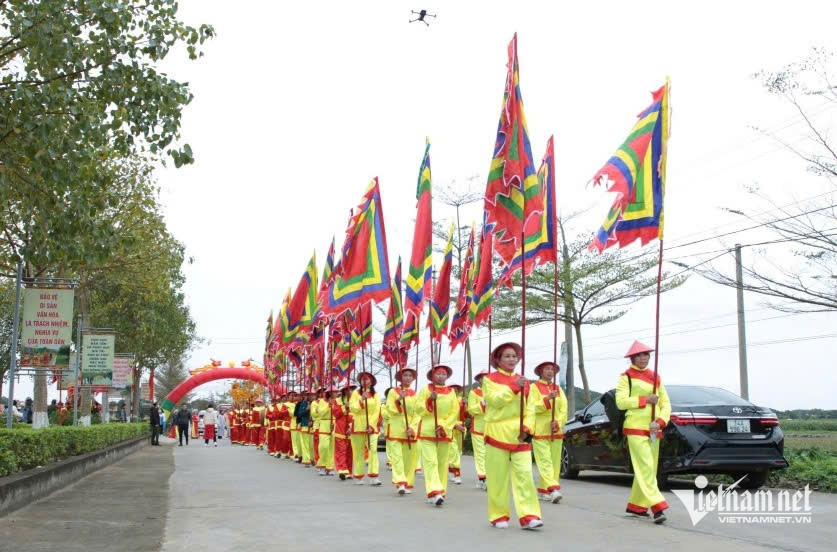
Since 2019, the Tran Dynasty Ancestral Temple Festival has been revived and held annually from the 18th to the 20th day of the first lunar month.
The opening day, which coincides with the death anniversary of Tran Thua, the dynasty's founding patriarch, attracts large numbers of local residents and visitors.
A highlight of the festival is the ceremonial water procession, which recreates a traditional practice associated with the Tran family's origins in river-based fishing.
In Vietnamese folk beliefs, water symbolizes life, fertility and the vital energy that sustains all living things.
The ritual therefore serves not only as an expression of gratitude toward ancestors but also as a prayer for favorable weather, abundant harvests, national peace and prosperity, and the well-being of the people.
Through festival activities, the origins and history of the Tran Dynasty are brought vividly to life, helping younger generations connect with the country's cultural traditions.
The temple's heritage is thus preserved not only through its architecture and archaeological remains but also through living cultural practices sustained by the local community.
Amid the changes of modern life, the Tran Dynasty Ancestral Temple remains an enduring historical landmark where memories of the past continue to intersect with Vietnam's contemporary cultural identity.
Linh Giang

