 Vietnamnet.vn

 Podcast



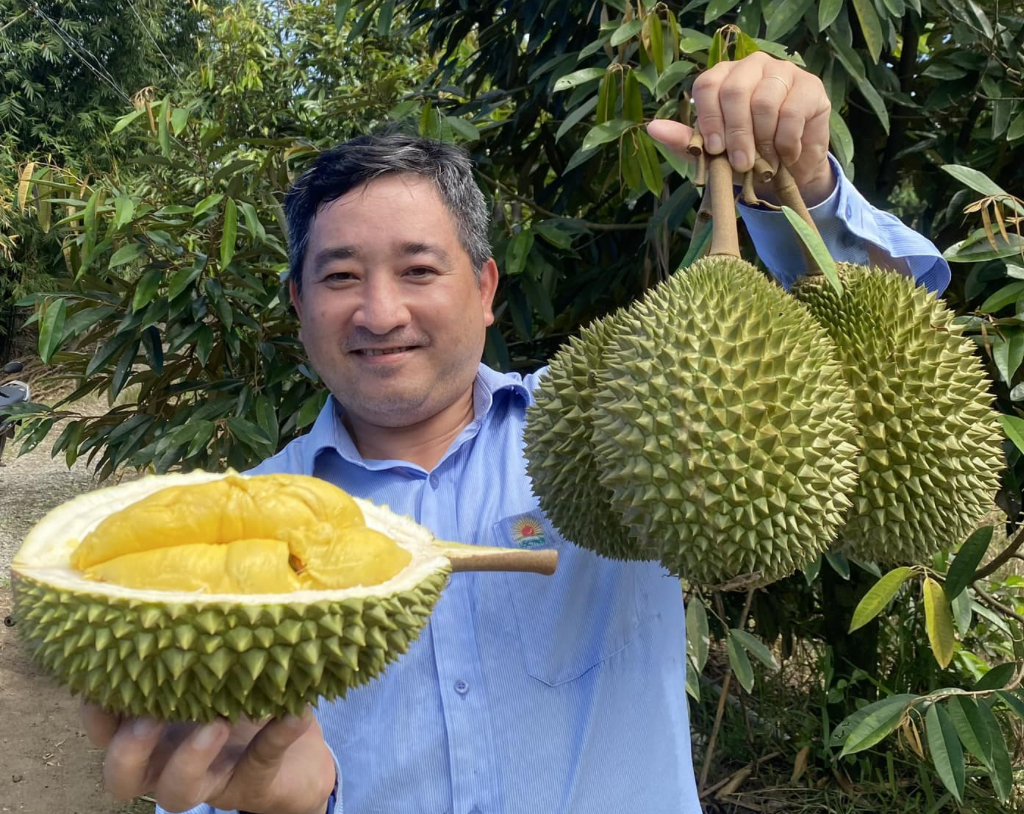
On August 20, China’s General Administration of Customs (GACC) approved 401 additional growing-area codes and 166 packing-facility codes for Vietnamese durian.
Vietnam now has a total of 1,917 durian growing-area codes approved by the GACC, according to a representative of the Department of Crop Production and Plant Protection under the Ministry of Agriculture and Environment.
The approval of a large number of additional growing areas and packing facilities expands Vietnam’s capacity to export durian to China through official channels, particularly as the billion-dollar fruit enters its peak harvest season in the Central Highlands.
Notably, Vietnamese durian has received a succession of positive developments in major Asian markets over the past month.
On August 5, the GACC authorized 50 testing facilities to conduct checks for cadmium and Auramine O on durian destined for China.
Together, the laboratories can process between 10,000 and 13,000 samples a day. The current testing network is essentially capable of meeting demand for durian exports to China even during the peak season, according to Pham Van Duy, deputy director of the Department of Agro-Forestry-Fisheries Quality, Processing and Market Development.
In mid-July, the Indian government issued new import regulations that added Vietnam to the list of countries permitted to export fresh durian to India.
The move gives Vietnamese durian another opportunity to reach a market of more than 1.4 billion people, where a growing middle class is driving stronger demand for high-quality imported agricultural and food products.
Vietnam’s durian production is forecast to reach around 2.08 million tons this year, roughly on par with and slightly above Thailand’s 2.07 million tons. That puts Vietnam in a strong position to narrow the gap with its regional rival in exports.
Dang Phuc Nguyen, general secretary of the Vietnam Fruit and Vegetable Association, said that if export conditions remain favorable, Vietnam could overtake Thailand to become the world’s largest durian exporter.
The gap has already narrowed considerably. In 2025, Vietnam’s share by volume in China, the world’s largest durian-consuming market, was nearly equal to Thailand’s.
Speaking to VietNamNet, Nguyen said durian orchards planted between 2021 and 2023 in the Central Highlands and southeastern Vietnam are set to enter their peak-yield years, potentially lifting the country’s total annual output above 2.2-2.5 million tons.
If Vietnam can effectively manage food safety and standardize growing-area codes, its durian export revenue could stabilize at $4.5-5 billion annually.
But if quality inspections are allowed to slip, Nguyen warned, Vietnam could lose market share to competitors very quickly.
He expects Vietnamese durian exports to reach $4 billion in 2026 and potentially climb to $4.5 billion if the current export pace is sustained.
Era of sky-high prices is coming to an end
Yet as Vietnam moves closer to the world’s top position, Nguyen believes its durian industry will undergo a major transition over the next three to four years, from 2027 to 2030.
The period of rapid production growth will gradually give way to a phase in which quality is filtered more rigorously, the market structure is reshaped and competition increasingly centers on the entire value chain.
As durian supply surges, pressure to stabilize prices will become increasingly pronounced.
Nguyen said the days when mixed-grade durian at the farm gate commonly fetched VND100,000-150,000 ($3.80-5.70) per kilogram are unlikely to continue.
Instead, prices are expected to move toward a more sustainable equilibrium of around VND40,000-70,000 ($1.50-2.70) per kilogram, depending on variety and quality.
Profitability will also become increasingly uneven.
Orchards planted outside designated production zones, those producing low-quality fruit, or crops with high rates of uneven ripening or heavy-metal contamination could suffer significant losses and risk being pushed out of the market altogether.
Between 2027 and 2030, Vietnam’s durian industry is also expected to see a marked shift in both its product structure and value chain.
The share of exports consisting solely of fresh whole fruit is expected to decline, while frozen durian - both whole and separated into flesh segments - and more deeply processed products could rise to account for around 30-40% of total export value.
Traceability is expected to become fully digitalized. Requirements governing cadmium levels, pesticide residues and GlobalGAP certification will become mandatory conditions for maintaining export codes.
At the same time, international competition is set to intensify sharply.
Thailand is focusing on tighter standards for natural ripeness and Brix levels while expanding rail logistics to shorten delivery times.
Malaysia, meanwhile, is accelerating exports of premium fresh varieties such as Musang King and Black Thorn to serve China’s high-end consumer segment.
The Philippines, Cambodia and Laos, along with experimental growing areas on China’s Hainan Island, are also expected to add significant volumes to the market.
Nguyen said the influx of supply from multiple countries into China would put substantial downward pressure on durian prices.
Lower prices, however, could make the fruit affordable to a much broader consumer base. That, in turn, could drive continued growth in Chinese demand and create further opportunities for Vietnamese exporters.
One Chinese company has also estimated that around one billion people in the country have never eaten durian, while retail demand continues to rise, particularly for high-quality fruit and premium brands.
As competition intensifies, Vietnam has advantages beyond its growing production volumes.
Its ability to harvest durian across different seasons throughout the year gives exporters greater flexibility, while its geographical proximity to China helps reduce transportation costs.
But maintaining and strengthening Vietnam’s position will require the industry to move beyond growth driven largely by volume and compete instead on quality and value across the entire supply chain.
Tam An
.svg)
