 Vietnamnet.vn

 Podcast



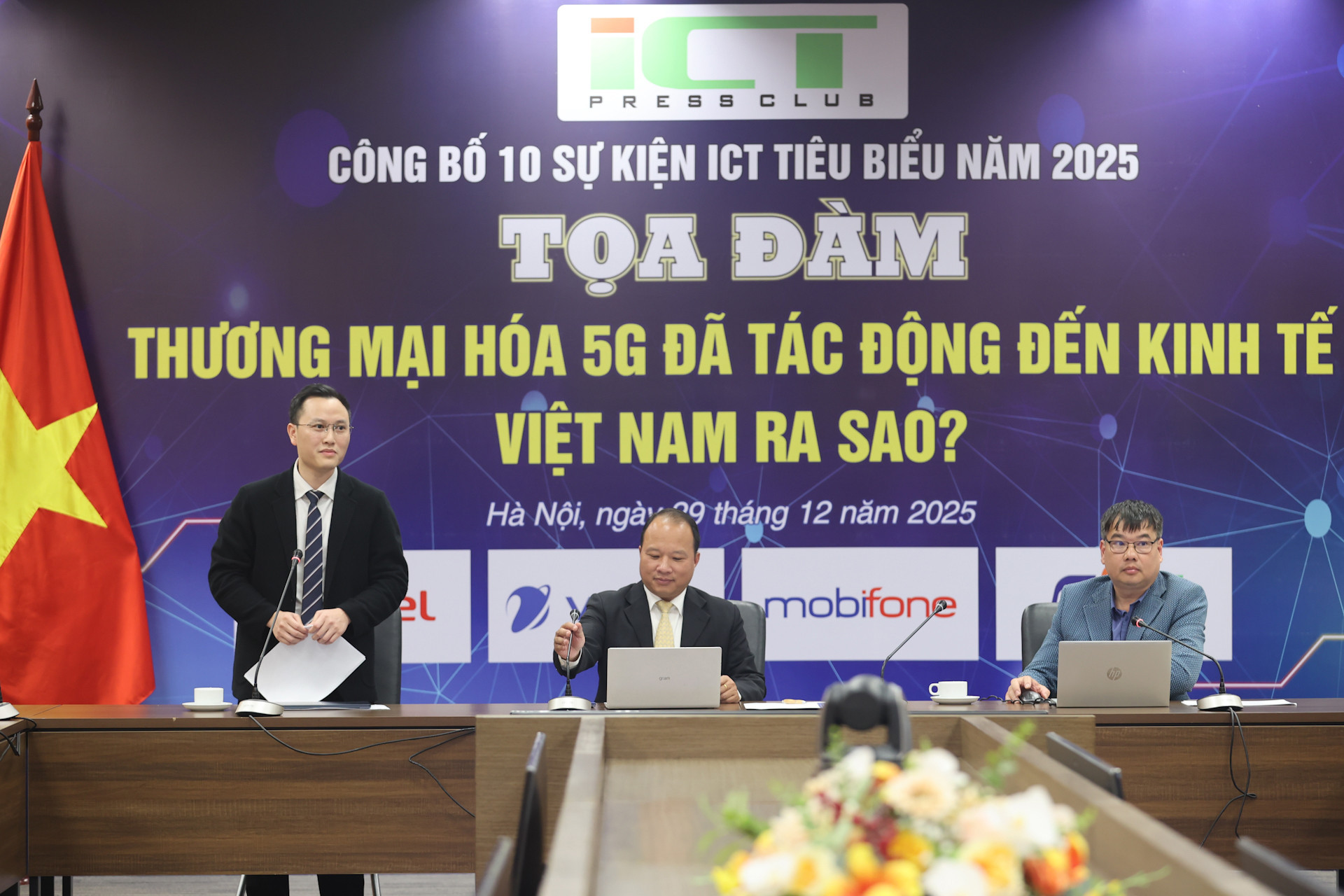
On December 29, the Vietnam ICT Press Club announced the Top 10 ICT Events of 2025, as voted by nearly 50 journalists from more than 40 Vietnamese media outlets. Alongside the announcement, the Club also hosted a roundtable titled: “How has 5G commercialization impacted Vietnam’s economy?”
Opening the event, Nguyen Viet Phu, Chairman of the ICT Press Club, noted that 2025 was a landmark year for Vietnam’s information and communications technology (ICT) sector. A host of sweeping policies were launched concerning institutional reforms, cybersecurity, data, strategic technology, and the digital economy - all implemented nationwide.
From a broader perspective, 2025 was not just about accelerating digital transformation - it was about shaping the long-term architecture of a digital Vietnam.
A comprehensive legal framework for the digital space
In 2025, Vietnam’s National Assembly passed an unprecedented set of laws that collectively cover nearly the entire digital space.
In 2025, the National Assembly passed an extensive legislative package covering virtually all aspects of the digital realm. These included the Law on Science, Technology and Innovation; the Law on Digital Technology Industry; the Digital Transformation Law; the Law on Artificial Intelligence (AI); the Law on E-commerce; the amended Intellectual Property Law; the amended Law on Technology Transfer; and the revised Law on High Technology.
These laws are notable not just for their breadth, but for their consistent legislative vision: treating technology, data, and innovation as central drivers of development, while governing the digital space as a unified socio-economic-security ecosystem.
The passage of the Law on AI on December 10 placed Vietnam among a rare group of countries with a comprehensive legal framework for artificial intelligence. The law outlines principles for managing risk, legal responsibilities, transparency, and ethical considerations, ensuring that technological advancement aligns with human rights and social benefits.
The Law on Digital Technology Industry, passed on June 14, provides a comprehensive legal foundation for sectors including semiconductors, AI, blockchain, and digital assets. It enhances Vietnam’s capacity to develop cutting-edge technologies and boost global competitiveness.
Resolution 57 becomes a national development axis
Following the Politburo's issuance of Resolution No. 57-NQ/TW on science, technology, innovation, and digital transformation, Vietnam's political system mobilized with rare urgency. On January 9, the government issued Resolution No. 03/NQ-CP outlining its implementation plan. This was followed by Resolution No. 71/NQ-CP on April 1, updating and supplementing the original action program.
The National Assembly also adopted Resolution No. 193/2025/QH15, introducing special mechanisms and policies to catalyze scientific and technological breakthroughs. Dozens of related bills, decrees, and circulars were passed, creating a consistent and dynamic policy pipeline.
Notably, major tech firms such as Viettel, VNPT, FPT, and CMC actively participated in implementing Resolution 57, aligning their efforts with the dual-level local government model introduced on July 1.

This shift confirms that ICT is no longer a supporting sector - it is now a core tool for national governance reform and a driving force for socio-economic growth.
One structural milestone in 2025 was the official merger of the Ministry of Information and Communications and the Ministry of Science and Technology, effective March 1. This reform, guided by Resolution No. 18-NQ/TW, aims to streamline government operations and improve oversight in technology, digitization, and communications.
Under the new structure, media and public information responsibilities were transferred to the Ministry of Culture, Sports and Tourism, while cybersecurity and information safety functions went to the Ministry of Public Security. The restructured Ministry of Science and Technology now acts as the central authority overseeing science, innovation, and digital transformation - the “brain” of the national digital strategy.
Cybersecurity and data protection: Pillars of a secure digital future
On December 10, the National Assembly passed the amended Cybersecurity Law, which merged it with the Law on Network Information Security. This unified legal framework eliminates overlap, enhances enforcement, and strengthens Vietnam’s capacity to counter increasingly sophisticated and cross-border cyber threats.
Previously, on June 26, the legislature passed the 2025 Personal Data Protection Law, effective January 1, 2026. The law establishes new regulations for collecting, processing, storing, and safeguarding personal data. It ensures citizens' privacy while building public trust in digital services and the digital economy.
A cyberattack on the National Credit Information Center (CIC) in September 2025 served as a real-world stress test for Vietnam’s cybersecurity response. The swift coordination among government agencies showcased Vietnam’s growing cyber defense capabilities and underscored the need to treat cybersecurity as a foundational element of sustainable development.
Strategic technologies and emerging growth arenas
On June 12, the Prime Minister signed Decision No. 1131/QD-TTg approving a list of strategic technologies and products. The list includes 11 technology clusters and 35 product groups across key sectors such as AI, semiconductors, blockchain, robotics, 5G/6G, aerospace, next-generation biomedicine, and cybersecurity.
Soon after, the Ministry of Science and Technology identified six priority products for deployment in 2025: Vietnamese-language large language models and virtual assistants, edge-processing AI cameras, autonomous robots, 5G network equipment, blockchain infrastructure, and unmanned aerial vehicles (UAVs). These fields offer both rapid commercialization potential and strategic importance for productivity, national security, and tech exports.
In parallel, the government issued Resolution No. 05/2025/NQ-CP, launching a pilot program for the digital asset market - Vietnam’s first legal framework for this rapidly expanding sector. With tens of millions of digital asset accounts and hundreds of billions of USD in transaction volume, the pilot is expected to unlock a new growth area for the digital economy while enhancing transparency and regulatory control.
2025 also marked Vietnam’s entry into the low-altitude economy, with UAV technology designated as a strategic focus. Vietnamese firms have begun to integrate more deeply into global value chains, laying the groundwork for a new high-tech economic sector projected to reach tens of billions of USD in the coming years.
Chairman Nguyen Viet Phu emphasized that a highlight of Vietnam’s ICT progress in late 2025 was the Ministry of Science and Technology’s recognition of Viettel’s achievements in deploying a 5G network. Viettel installed 22,758 5G base stations, surpassing its commitment to the government of at least 20,000.
This demonstrates the company’s strong commitment to turning the government’s digital policies into action, advancing the goal of nationwide 5G coverage by 2030 as set out in Resolution 57-NQ/TW. Viettel is now the country’s largest 5G provider, with a total of 30,000 base stations covering 90% of outdoor areas and 70% of indoor spaces nationwide, from urban to rural regions.
Top 10 ICT events in Vietnam in 2025
The National Assembly passed a wave of landmark laws governing science, technology, innovation, digital transformation, journalism, and media.
The government and all political levels aggressively implemented Resolution No. 57-NQ/TW.
The Ministry of Information and Communications merged with the Ministry of Science and Technology; key functions were reassigned to the Ministry of Public Security and the Ministry of Culture, Sports and Tourism.
The National Assembly passed the 2025 Cybersecurity Law and Personal Data Protection Law, drafted by the Ministry of Public Security.
Vietnam unveiled 11 strategic technology clusters.
Vietnam successfully hosted the signing ceremony of the Hanoi Convention.
The government launched a pilot program for the digital asset market.
Authorities cracked down on celebrities and influencers for misleading advertisements and subpar online products.
The National Credit Information Center (CIC) was targeted in a cyberattack.
Vietnam entered the low-altitude economy, embracing UAV technology as a new growth engine.
Du Lam
.svg)
