 Vietnamnet.vn

 Podcast



Thirty years ago, Vietnam’s wood industry was preoccupied with one question: how to export more. Today, a more important question has emerged: how much value can Vietnam retain within the global value chain?
In 2025, exports of wood and forestry products reached US$18.3 billion, placing Vietnam among the world’s leading hubs for wood furniture production and exports.
Yet in the first six months of 2026, exports grew by just 4.4%, while deeply processed products declined by 2.7%. Growth came mainly from wood chips, pellets and industrial wood panels.
These figures show that the industry’s challenge is no longer simply to export more, but to create more value.
The challenge lies in the biggest market
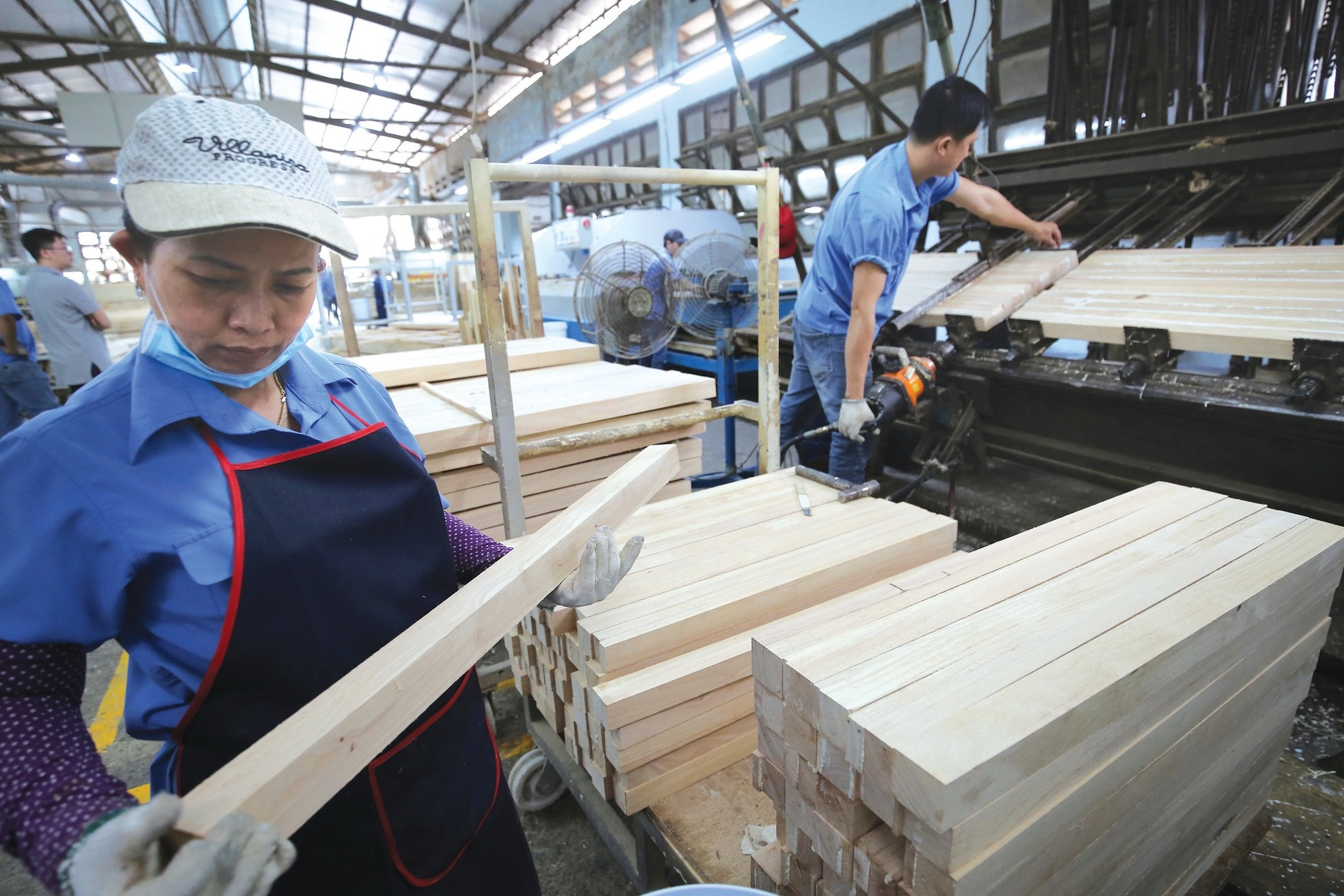
The United States is the most important market for Vietnam’s wood industry. In 2025, exports of wood and wood products to the US reached US$9.46 billion, accounting for 54.6% of the industry’s total export turnover.
Together, five markets - the United States, Japan, China, the EU and South Korea - account for nearly 90% of export turnover, highlighting the industry’s heavy dependence on a small number of destinations.
This concentration allows businesses to benefit from economies of scale and production specialization, but it also limits their ability to redirect orders, leaving the entire industry more vulnerable to policy changes in partner markets.
The more successful Vietnam’s wood industry becomes in the United States, the greater the trade pressure it faces. Plywood is currently subject to a preliminary determination by the US Department of Commerce, with anti-dumping margins for certain parties reaching as high as 196.14%, while the preliminary countervailing duty rate stands at 15.56%. These are two separate mechanisms and cannot simply be added together, but they illustrate the scale of the risk involved.
Meanwhile, upholstered furniture, kitchen cabinets, tables and vanities are subject to tariffs of 25% under Section 232. The United States has also expanded Section 301 investigations involving excess capacity, forced labor and potential intellectual property rights violations. Although these investigations do not necessarily translate into final tariffs, they have already created considerable uncertainty for production, investment and product pricing plans.
More concerning is the imbalance in the power to set the rules of the game. Vietnamese businesses can submit arguments, participate in hearings and provide evidence, but they cannot determine how the United States designs and applies its trade instruments. A single change in criteria, margin calculations or product scope can disrupt a business model built over many years.
From passive growth to taking greater control
Over the past 30 years, Vietnam’s forestry and wood industries have expanded rapidly, but much of that growth has followed a largely reactive trajectory. Export turnover has risen steadily, yet the value retained domestically has not kept pace, while resilience to external shocks remains limited. A single disruption - whether a US tariff earthquake, geopolitical conflict or a sharp rise in logistics costs - can immediately upend the production and business plans of hundreds of companies.
Until now, many businesses have only begun responding after tariffs are announced, trade remedy proceedings are initiated or transport chains are disrupted. This approach leaves companies perpetually on the defensive, consuming resources and making it difficult to protect profit margins. An industry may have a large export footprint, but without strong forecasting and early-warning capabilities, it remains highly vulnerable.
Being proactive does not mean being able to dictate the rules of global trade. It means strengthening the ability to forecast developments, identify risks early, prepare response scenarios and participate more actively in the formation of rules that directly affect the industry. Trade remedies, origin management, supply chain data, market diversification and contingency funds need to become integral components of competitiveness rather than measures introduced only after a crisis has already erupted.
The global rules are changing
The global wood value chain is being reshaped by trade geopolitics, the green transition, new technologies and rising protectionism.
On the demand side, slower growth, high interest rates and weak housing markets are weighing on demand for wood furniture. ITTO recorded a decline in global wood furniture trade in 2025, while businesses face increasingly high costs for energy, logistics, capital and compliance.
At the same time, traceability, anti-deforestation requirements, emissions reporting and due diligence are becoming conditions for access to major markets. The EU is preparing to implement the EUDR, the United States continues to enforce the Lacey Act alongside trade remedy measures, and many other markets are also tightening requirements on product legality.
Yet the green transition does not only create additional costs. FAO forecasts that global demand for materials could increase by around 60% by 2060. With its renewable nature and ability to store carbon, sustainably sourced wood has an opportunity to become a strategic material for the bioeconomy and low-emission construction.
The paradox of the “no further growth” trap
A growth model based on contract manufacturing, capacity expansion and concentration on a handful of key markets has enabled Vietnam’s wood industry to make remarkable gains over many years. But as the business environment changes, that same model is revealing its limitations.
This is the “no further growth” trap: revenue and output continue to rise, but the value retained within Vietnam does not increase proportionately. When businesses compete primarily on price, control over design, brands, distribution systems and consumer data remains in the hands of their customers. The largest share of value therefore sits outside the factory, while manufacturers bear the costs of raw materials, labor, logistics, compliance and trade remedies. A single tariff increase of 20-25% can exceed a manufacturer’s entire profit margin.
Profit margins are becoming increasingly compressed, while investment costs and legal and market risks continue to rise. Greater scale, therefore, does not necessarily translate into stronger competitiveness. Instead, it can make businesses even more exposed to external shocks.
Nor does the risk come only from the United States. The EU requires businesses to comply with the EUDR, traceability and due diligence requirements, while other markets are continually raising environmental and social standards. If businesses continue to compete primarily on volume and low prices, they will have to absorb additional compliance costs while finding it extremely difficult to pass those costs on through higher selling prices.
Five strategic shifts for Vietnam’s wood industry
To move from an export powerhouse to a high-value wood processing hub, Vietnam’s wood industry needs to undertake five strategic shifts.
Increase value rather than merely export turnover through deeper processing, design, branding and intellectual property.
Take greater ownership of innovation by strengthening design capabilities, product development and technology adoption.
Turn green standards into a competitive advantage, treating traceability and sustainable development as foundations for market access.
Build transparent supply chains, diversify markets and strengthen trade defense capabilities.
Stay ahead of global disruptions by improving forecasting and early-warning systems and participating more actively in shaping trade rules.
Thirty years ago, Vietnam’s wood industry succeeded by becoming exceptionally good at making what the world needed. Over the next 30 years, its success will depend on whether Vietnam can create value that the world cannot easily replace. That will be the true measure of a global wood industry powerhouse.
Nguyen Quoc Khanh (Chairman of the Vietnam Timber and Forest Products Association)
.svg)
