 Vietnamnet.vn

 Podcast



This is Phuc Xa Communal House and Bac Bien Pagoda - places dedicated to Grand Chancellor Viet Quoc Cong Ly Thuong Kiet, a native son of the former An Xa village. For more than 1,000 years, local residents have remained devoted to preserving the “civilized and humane traditions” handed down since the village’s earliest days.
The ancient “An Xa Tu Chung” bell - a treasured relic of Ly Thuong Kiet’s homeland
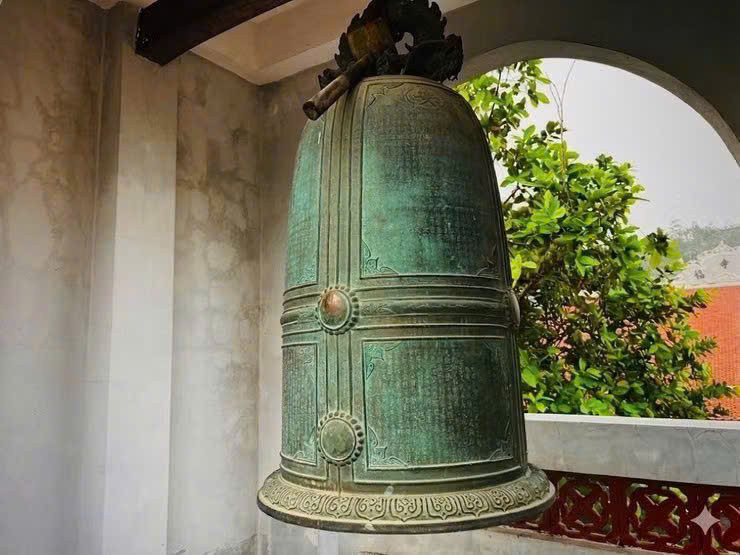
The ancient bronze bell at Bac Bien Pagoda contains more than 5,500 Chinese characters preserving royal decrees from multiple dynasties.
Hanging in the bell tower at the entrance of Bac Bien Pagoda - originally named An Xa Tu and later renamed Phuc Xa Tu - is a large bronze bell measuring 1.2m in height and 0.65m in base diameter. The bell was cast in 1690 during the 11th year of the Chinh Hoa reign.
Its surface is densely engraved with more than 5,500 Chinese characters preserving the contents of nine royal decrees issued by kings and lords from the Mac and Le dynasties, spanning from the Mac Quang Hoa era (1544-1545) to the Later Le Restoration period.
The bell’s greatest historical value lies in a decree dating to the first year of the Thinh Duc era (1653). The inscription clearly states: “Trung thu xa nhan dinh uy Quan Chau Hau phong tu quoc tinh Ly Thuong Kiet…”
The document officially confirms that An Xa village - the former name of present-day Phuc Xa - Bac Bien - was the birthplace of Grand Chancellor Ly Thuong Kiet. Villagers honor him as the ancestral founder of the land.
The decree also recounts King Ly Thai To’s relocation of the capital in 1010. At the time, An Xa village lay within the inner grounds of Thang Long Citadel and was ordered to move to the midstream alluvial banks of the Red River to make way for the imperial capital. Without farmland to cultivate, villagers survived by growing mulberry and raising silkworms while being exempted from taxes, dyke duties and military conscription.
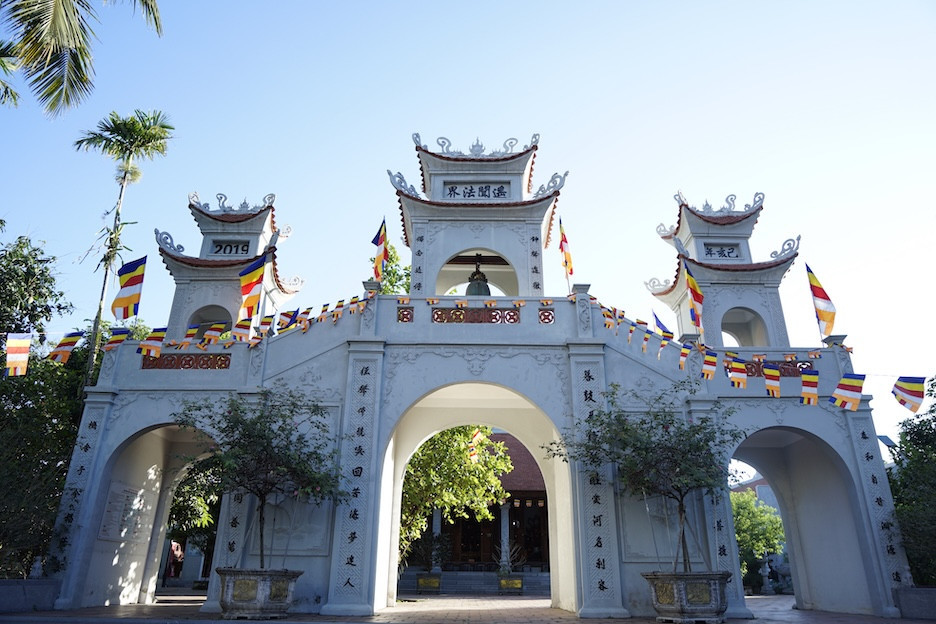
Phuc Xa Communal House worships village guardian deities and General Dao Ky.
In 1132, King Ly Than Tong traveled through the area by royal boat and saw villagers constantly relocating by boat to avoid flooding. He subsequently changed the village name from An Xa to Co Xa, with the word “Co” referring to mobility. In 1911, during the Duy Tan reign, Co Xa was renamed Phuc Xa. Though the village name changed over time, the historical connection and reverence for Ly Thuong Kiet never faded.
On February 3, 2026, the Prime Minister signed Decision No. 236/QD-TTg officially recognizing the An Xa Pagoda bell as a National Treasure.
Nguyen Van Tuyen, deputy head of the heritage subcommittee at Phuc Xa Communal House, said: “The bell is not simply an ancient artifact - it is the soul of the village. It preserves the birthplace of Ly Thuong Kiet, one of Vietnam’s most celebrated national heroes. Villagers are deeply proud and feel a responsibility to preserve it for future generations.”
Phuc Xa Communal House - dedicated to guardian deities and General Dao Ky
Beside the pagoda, Phuc Xa Communal House - also known as Bac Bien Communal House - stands on elevated ground facing an ancient lotus pond.
The communal house worships three guardian deities of the village: Minh Khiet Dai Vuong, Bao Trung Dai Vuong and Hieu Cong Dai Vuong, along with Princesses Hung Nuong and Hao Nga, who were said to have transported food supplies to support King Ly Thanh Tong.
Alongside these deities, the communal house also venerates General Dao Ky, a grand marshal under the Trung Sisters who was honored with the title Dung Luoc Te The Dai Vuong. Dao Ky died heroically at Co Loa in AD 43 and has been worshipped by villagers for generations.
As for Grand Chancellor Viet Quoc Cong Ly Thuong Kiet, villagers revere him both as the village tutelary deity and ancestral founder. Inside the communal house, a pair of parallel sentences praises his achievements:
“Defeated the Song, subdued Champa, upheld the Ly dynasty’s legacy / Helped the people, saved the nation, brought glory to Co village.”
In 2006, a bronze bust of Ly Thuong Kiet was ceremonially brought into the rear sanctuary of the communal house in preparation for the 1,000th anniversary of Thang Long - Hanoi. In July 2020, villagers solemnly escorted the statue into the Mother Goddess shrine to be worshipped alongside Saint Tran.
The water procession festival and communal feast tradition
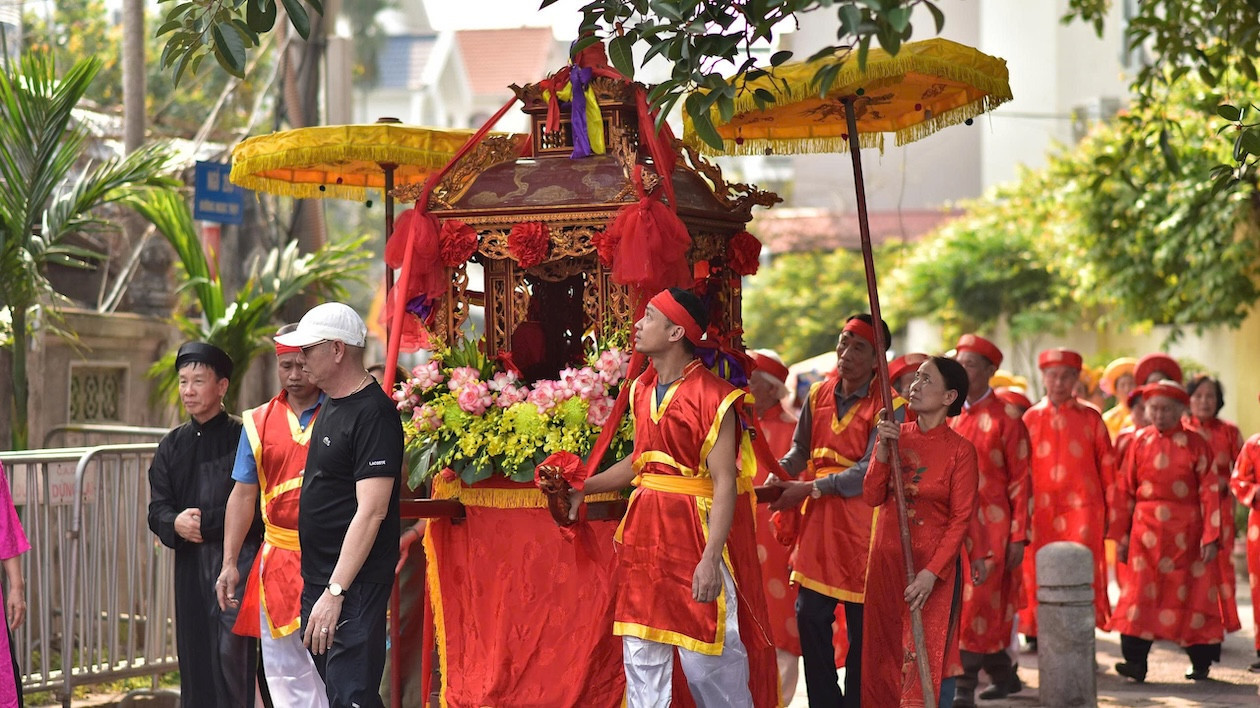
The annual water procession festival remains one of the village’s most sacred traditions.
Every year on the sixth day of the third lunar month, Phuc Xa village holds its annual festival.
The celebration begins with a water procession ceremony from the Red River to the communal house. This ritual is a distinctive cultural tradition among riverside communities, symbolizing prayers for favorable weather while expressing gratitude to the river that sustained generations of farming and sericulture families.
Alongside the water procession is the “ruoc van” ritual procession. To show reverence to the saints, ceremonial prayers are solemnly drafted at Den Ong temple, located beside the riverbank, before being carried together with jars of river water to the communal house on the eve of the main festival day.
Following the procession comes the “dong dan hoi am” communal feast, during which villagers gather to receive blessed offerings together at the communal house.
The village convention of Phuc Xa clearly states: “Inside the communal house, mats are reserved for women who contributed to the village and nation, and for wives of men holding official village status.”
This cultural tradition stands in sharp contrast to old feudal concepts that excluded women from communal house activities. During the gathering, villagers assemble in front of the communal house to respectfully report annual achievements to the saints, including harvests, education and cultural development, while praying for blessings and expressing gratitude.
The ceremony remains a deeply distinctive communal practice - both sacred and intimate - preserved through generations despite historical upheavals.
The festival also features palanquin processions, incense offerings, ceremonial rites, folk games and traditional performances. In particular, on the second day of the sixth lunar month - the death anniversary of Ly Thuong Kiet - villagers organize another solemn memorial ceremony.
A village of culture and heroism
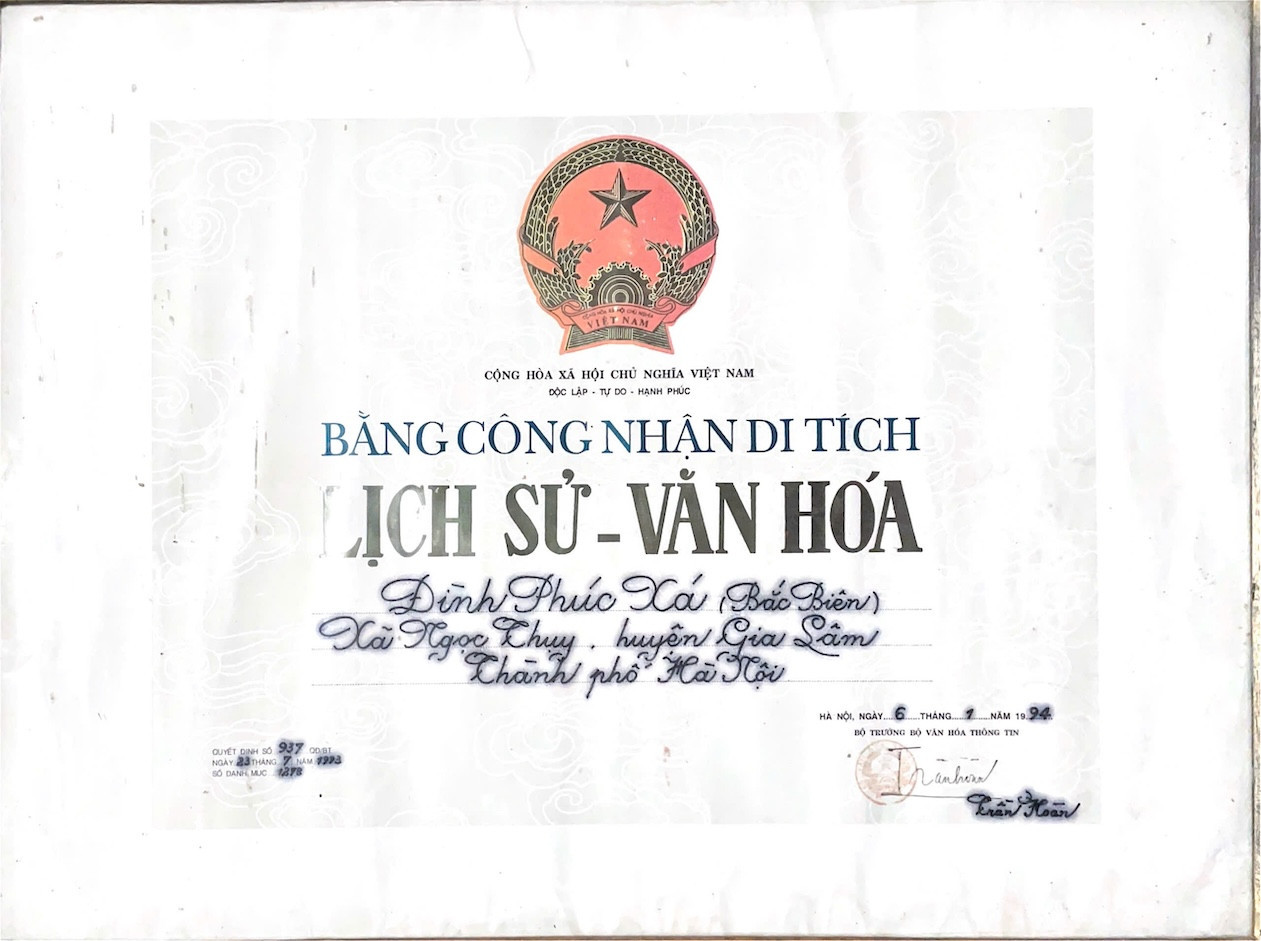
Phuc Xa - Bac Bien village preserves both cultural heritage and heroic wartime memories.
Beyond preserving national treasures and ancient festivals, Phuc Xa - Bac Bien village is also the homeland of many fallen heroes who sacrificed their lives across Vietnam’s battlefields.
Nguyen Phu Xuyen Khung, commander of Engineering Company M83 and a Hero of the People’s Armed Forces, led the digging of a 47m tunnel through Hill A1 during the Dien Bien Phu Campaign. Nearly one ton of explosives was planted beneath the French stronghold, collapsing the final bunker and opening the way for Vietnamese troops to storm the command center and capture General De Castries on May 6, 1954.
Another native son, Colonel Nguyen Phu Vy, also honored as a Hero of the People’s Armed Forces, fought in more than 30 major battles and received three Military Exploit Orders. After peace returned, he became known as a key military trainer for southern battlefields, helping train tens of thousands of recruits, including soldiers from Division 325B who later advanced into Saigon in 1975.
Hero of the People’s Armed Forces Nguyen Ngoc Nai is remembered through another extraordinary story. During Hanoi’s 60-day resistance campaign, he served as leader of a special communications unit. On the night of February 17, 1947, he and seven soldiers guided the Capital Regiment out of Interzone I. Two days later, the entire team was killed in Tam Xa mulberry fields while protecting the regiment’s withdrawal.
In 2015, the Ngoc Thuy Ward Martyrs Memorial was inaugurated within the grounds of Phuc Xa Communal House. The names of fallen heroes are engraved beside the national memorial monument. Since then, village children have been brought there during holidays and festivals to hear stories about relatives who died in Dien Bien, Tam Xa and southern battlefields.
Phuc Xa - Bac Bien village is home to seven Vietnamese Heroic Mothers, 181 martyrs, nine veteran revolutionaries, 11 pre-uprising cadres, 20 former political prisoners and recipients of 1,596 medals and state honors.
Those figures, together with the national treasure bell and thousand-year-old water procession festival, have shaped a unique “cultural and heroic” village along the Red River - a place where ancestral heritage and the spirit of modern Vietnam merge into one.
Tra My
.svg)
